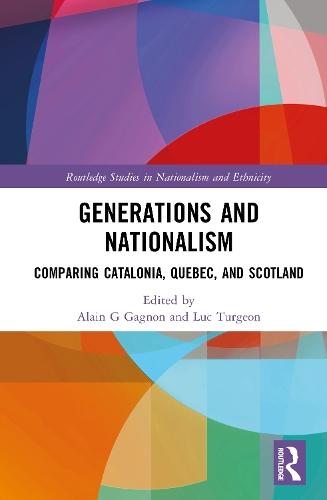
Full Product Details
Author: Alain-G Gagnon ,
Luc Turgeon
Publisher: Taylor & Francis Ltd
Imprint: Routledge
Weight: 0.610kg
ISBN: 9781032979182
ISBN 10: 1032979186
Pages: 228
Publication Date: 02 September 2025
Audience:
College/higher education
,
Professional and scholarly
,
Tertiary & Higher Education
,
Professional & Vocational
Format: Hardback
Publisher's Status: Active
Availability: Not yet available

This item is yet to be released. You can pre-order this item and we will dispatch it to you upon its release.
Reviews
“This unique volume brings together leading scholars to tackle the underexamined question of generational change and nationalism, with a focus on the “small nations” of Catalonia, Scotland Quebec that are internal to states. What emerges is a gripping comparative account of how, as a result of generations, nationalist movements may shift in orientation, and support for nationalist projects like independence may ebb and flow. In providing new pathways and theoretical anchors for explaining continuity and change, this collection is essential reading for understanding nationalism as a force shaping the 21st century.” Yasmeen Abu-Laban, Professor of Political Science and Canada Research Chair in the Politics of Citizenship and Human Rights, The University of Alberta “Studies of nationalism frequently refer to differences amongst generations but this is the first truly comparative, conceptually sophisticated and thoroughly researched study of the phenomenon. It will be essential reading for those interested in Quebec Catalonia and Scotland for students of nationalism in general.” Michael Keating, Emeritus Professor of politics, Universities of Aberdeen and Edinburgh “This collective work focuses on an interesting and renewed analytical subject: the role played by different generations or citizens’ cohorts in nationalist and secessionist movements in current liberal democracies. The approach includes cohort, life-cycle and period effects through a critical conceptual framework and a comparative analysis between three empirical cases: Quebec, Scotland and Catalonia. In continuity with the Mannheim classical seminal work on “The Problem of Generations” and the post-war scholar literature on recognition and political accommodation of minority nations in plurinational states, this book accurately highlights how generational changes influence national and secessionist movements. This work may acquire a special relevance for other minority nations that share with the analysed cases the support of liberal democratic values, the rejection of violence, inclusive conceptions of national membership, as well as specific failures in their respective constitutional states at the moment of achieving political recognition and a just and workable constitutional accommodation.” Ferran Requejo, Professor of Political Science, Universitat Pompeu Fabra (Barcelona)
""This unique volume brings together leading scholars to tackle the underexamined question of generational change and nationalism, with a focus on the 'small nations' of Catalonia, Scotland and Quebec that are internal to states. What emerges is a gripping comparative account of how, as a result of generations, nationalist movements may shift in orientation, and support for nationalist projects like independence may ebb and flow. In providing new pathways and theoretical anchors for explaining continuity and change, this collection is essential reading for understanding nationalism as a force shaping the 21st century.” Yasmeen Abu-Laban, Professor of Political Science and Canada Research Chair in the Politics of Citizenship and Human Rights, The University of Alberta “Studies of nationalism frequently refer to differences amongst generations but this is the first truly comparative, conceptually sophisticated and thoroughly researched study of the phenomenon. It will be essential reading for those interested in Quebec, Catalonia and Scotland, and for students of nationalism in general.” Michael Keating, Emeritus Professor of politics, Universities of Aberdeen and Edinburgh “This collective work focuses on an interesting and renewed analytical subject: the role played by different generations or citizens’ cohorts in nationalist and secessionist movements in current liberal democracies. The approach includes cohort, life-cycle and period effects through a critical conceptual framework and a comparative analysis between three empirical cases: Quebec, Scotland and Catalonia. In continuity with the Mannheim classical seminal work on 'The Problem of Generations' and the post-war scholarly literature on recognition and political accommodation of minority nations in plurinational states, this book accurately highlights how generational changes influence national and secessionist movements. This work may acquire a special relevance for other minority nations that share with the analysed cases the support of liberal democratic values, the rejection of violence, inclusive conceptions of national membership, as well as specific failures in their respective constitutional states at the moment of achieving political recognition and a just and workable constitutional accommodation.” Ferran Requejo, Professor of Political Science, Universitat Pompeu Fabra (Barcelona)
Author Information
Alain-G Gagnon is Professor of Political Science and the Canada Research Chair of Quebec and Canadian Studies at the Université du Québec à Montréal, Canada. Luc Turgeon is Professor of Political Science at the University of Ottawa, Canada.