Overview
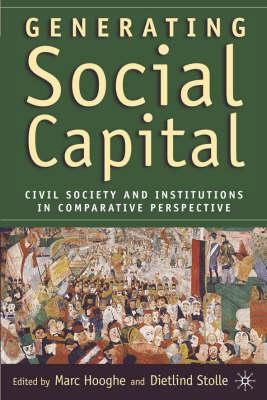
Social capital networks of civic engagements, norms of reciprocity, and attitudes of trust is widely seen as playing a key role for the health of democracy. While many authors have examined the consequences of social capital, there is a pressing need to explore its sources. This collection brings together leading American and European scholars in the first comparative analysis of how social trust and other civic attitudes are generated. The contributors to this volume examine the generation of social capital from two directions: society based approaches that emphasize voluntary associations, and institutional approaches that emphasize policy.
Full Product Details
Author: M. Hooghe ,
D. Stolle
Publisher: Palgrave USA
Imprint: Palgrave Macmillan
Edition: 2003 ed.
Dimensions:
Width: 14.00cm
, Height: 1.90cm
, Length: 21.60cm
Weight: 0.465kg
ISBN: 9781403962195
ISBN 10: 1403962197
Pages: 256
Publication Date: 17 July 2003
Audience:
College/higher education
,
Professional and scholarly
,
Undergraduate
,
Postgraduate, Research & Scholarly
Format: Hardback
Publisher's Status: Active
Availability: Out of stock

The supplier is temporarily out of stock of this item. It will be ordered for you on backorder and shipped when it becomes available.
Reviews
The diverse essays in this edited volume focus sharply on the important question: where does social capital come from? Using different analytical approaches to data culled from a variety of countries across three continents, the book advances our understanding of the nature and origins of social capital. --Ken Newton, University of Southampton Generating Social Capital is an excellent collection of original, thematically related essays and empirical reports. The great strengths of the book rest in its comparative perspective and in its challenges to and reinterpretations of the conventional literature. --M. Kent Jennings, Department of Political Science, University of California, Santa Barbara This nicely integrated volume significantly contributes to our understanding of the construction, destruction, and forms of social capital. Its focus on the institutions and contexts that produce trust lays the groundwork for both better public policy and better social science. --Margaret Levi, Jere L. Bacharach Professor of International Studies, University of Washington
The diverse essays in this edited volume focus sharply on the important question: where does social capital come from? Using different analytical approaches to data culled from a variety of countries across three continents, the book advances our understanding of the nature and origins of social capital. --Ken Newton, University of Southampton <br> Generating Social Capital is an excellent collection of original, thematically related essays and empirical reports. The great strengths of the book rest in its comparative perspective and in its challenges to and reinterpretations of the conventional literature. --M. Kent Jennings, Department of Political Science, University of California, Santa Barbara <br> This nicely integrated volume significantly contributes to our understanding of the construction, destruction, and forms of social capital. Its focus on the institutions and contexts that produce trust lays the groundwork for both better public policy and better social science. <br>--Margaret Levi, Jere L. Bacharach Professor of International Studies, University of Washington<br>
The diverse essays in this edited volume focus sharply on the important question: where does social capital come from? Using different analytical approaches to data culled from a variety of countries across three continents, the book advances our understanding of the nature and origins of social capital. --Ken Newton, University of Southampton<br><br> Generating Social Capital is an excellent collection of original, thematically related essays and empirical reports. The great strengths of the book rest in its comparative perspective and in its challenges to and reinterpretations of the conventional literature. --M. Kent Jennings, Department of Political Science, University of California, Santa Barbara<br><br> This nicely integrated volume significantly contributes to our understanding of the construction, destruction, and forms of social capital. Its focus on the institutions and contexts that produce trust lays the groundwork for both better public policy and better social science. <br>--Margaret Levi, Jere L. Bacharach Professor of International Studies, University of Washington<br>
The diverse essays in this edited volume focus sharply on the important question: where does social capital come from? Using different analytical approaches to data culled from a variety of countries across three continents, the book advances our understanding of the nature and origins of social capital. --Ken Newton, University of Southampton <br> Generating Social Capital is an excellent collection of original, thematically related essays and empirical reports. The great strengths of the book rest in its comparative perspective and in its challenges to and reinterpretations of the conventional literature. --M. Kent Jennings, Department of Political Science, University of California, Santa Barbara <br> This nicely integrated volume significantly contributes to our understanding of the construction, destruction, and forms of social capital. Its focus on the institutions and contexts that produce trust lays the groundwork for both better public policy and better social science. <br>--
Author Information
MARC HOOGHE is an Assistant Professor at the Free University of Brussels/ University of Antwerp in Belgium. DIETLIND STOLLE is an Assistant Professor at McGill University in Canada.