Overview
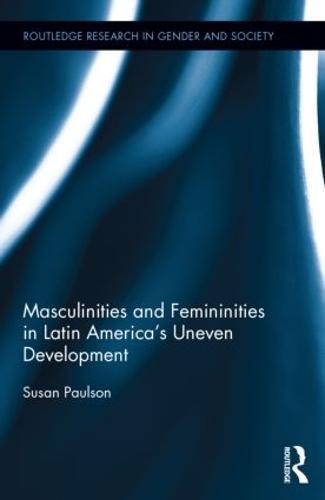
This book forges a new approach to historical and geographical change by asking how gender arrangements and dynamics influence the evolution of institutions and environments. This new theoretical approach is applied via mixed methods and a multi-scale framework to bring together unusually diverse phenomena. Regional trends demonstrated with quantitative data include the massive incorporation of women into paid work, demographic masculinization of the countryside and feminization of cities, rapidly increasing gaps that favor women over men in education and life expectancy, and extraordinarily high levels of violence against men. Case studies in Mexico, Chile and Bolivia explore changes influenced by gender practices and expectations that involve men in different ways than women; they also highlight dissimilarities and power relations between differently positioned masculine groups. Ethnographic studies of culturally diverse arrangements, together with particular attention to subordinate versus dominant masculinities, complicate the gender binaries that circumscribe so much research and policy. Drawing attention to imbalances and conflicts generated by inappropriate models and uneven developments, the book points to opportunities for experimenting with and adapting the sociocultural institutions that govern relations among humans and between humans and their environment.
Full Product Details
Author: Susan Paulson (University of Florida, USA)
Publisher: Taylor & Francis Ltd
Imprint: Routledge
Volume: 46
Dimensions:
Width: 15.20cm
, Height: 1.80cm
, Length: 22.90cm
Weight: 0.385kg
ISBN: 9781138843691
ISBN 10: 1138843695
Pages: 182
Publication Date: 09 September 2015
Audience:
College/higher education
,
Tertiary & Higher Education
,
Undergraduate
Format: Hardback
Publisher's Status: Active
Availability: In Print

This item will be ordered in for you from one of our suppliers. Upon receipt, we will promptly dispatch it out to you. For in store availability, please contact us.
Reviews
Susan Paulson's exciting and original text challenges the current thinking about gender in social sciences. Her unique contribution to gender scholarship is not only the focus on men and masculinity but also the ability to intersect socioeconomic gender differences with the concept of territoriality. In the three case studies and her insightful analytical chapters, Paulson poses critical questions about men and masculinity in Latin America in order to ask how individuals and communities strive to produce territories that provide sustainable communities, economies and ecologies. The book is a theoretical triumph that provides new ways to see and understand ongoing processes of gender relations in the sociocultural and biophysical spaces of Latin America's continuing uneven development. -Wendy Harcourt, Associate Professor in Critical Development and Feminist Studies, International Institute of Social Studies of Erasmus University Rotterdam (ISS/EUR), The Netherlands This book provides a welcome 'correction' to the woman-centered bias in the field of gender and development. Paulson demonstrates how analyses which focus solely on women not only miss half the story, but are also unsatisfactory without attention to the complex ways that gender intersects with class, race and ethnicity, and space, among other factors. Case studies drawn from Mexico, Chile and Bolivia well illustrate her main point, that gender arrangements and dynamics influence the evolution of institutions and environments. By analyzing how gender systems impact upon and are impacted by broader processes of socioeconomic and cultural change she illustrates how these dynamics can sometimes produce greater gender equity while at the same time exacerbating other forms of inequality, and vice versa. This book should be required reading in gender and development courses; it should also serve as a stimulating complementary text in courses on Latin American anthropology, geography and economic development. -Carmen Diana Deere, Distinguished Professor of Latin American Studies and Food & Resource Economics, University of Florida This is a brilliant, indeed an indispensable book. It provides a compelling diagnosis of the decline and failure of the contemporary bureaucratic and managerially governed university, the post-industrial-bureaucratic driven economy, and the social-liberal-democratic-bureaucratic state. -Wayne Cristaudo, Journal of Economics Library (Volume 3, 2016) The framework brilliantly developed by Paulson reflects important long and broad collaborative research from Latin Americans and Latinoamericanists coming from different fields and disciplines, mainly under the support of RIMISP (Red International de Metodologia de Investigacion de Sistemas de Produccion) and her own research engagement with this region for more than two decades, which produced important scholarship on ethnic and gender identities and their role in changes in the use of territory.There is no doubt that this book is a major milestone for shifting the conceptualization and practice addressing gendered sociocultural processes that produce, sustain and sometimes transform uneven geographies of development [1]. It can open up a new way of understanding gender, leading to more equitable and sustainable development. -Cristina Espinosa, E-International Relations (2016) There is no doubt that this book is a major milestone for shifting the conceptualization and practice addressing gendered sociocultural processes that produce, sustain and sometimes transform uneven geographies of development . It can open up a new way of understanding gender, leading to more equitable and sustainable development. -E-International Relations
Susan Paulson's exciting and original text challenges the current thinking about gender in social sciences. Her unique contribution to gender scholarship is not only the focus on men and masculinity but also the ability to intersect socioeconomic gender differences with the concept of territoriality. In the three case studies and her insightful analytical chapters, Paulson poses critical questions about men and masculinity in Latin America in order to ask how individuals and communities strive to produce territories that provide sustainable communities, economies and ecologies. The book is a theoretical triumph that provides new ways to see and understand ongoing processes of gender relations in the sociocultural and biophysical spaces of Latin America's continuing uneven development. -Wendy Harcourt, Associate Professor in Critical Development and Feminist Studies, International Institute of Social Studies of Erasmus University Rotterdam (ISS/EUR), The Netherlands
Susan Paulson's exciting and original text challenges the current thinking about gender in social sciences. Her unique contribution to gender scholarship is not only the focus on men and masculinity but also the ability to intersect socioeconomic gender differences with the concept of territoriality. In the three case studies and her insightful analytical chapters, Paulson poses critical questions about men and masculinity in Latin America in order to ask how individuals and communities strive to produce territories that provide sustainable communities, economies and ecologies. The book is a theoretical triumph that provides new ways to see and understand ongoing processes of gender relations in the sociocultural and biophysical spaces of Latin America's continuing uneven development. -Wendy Harcourt, Associate Professor in Critical Development and Feminist Studies, International Institute of Social Studies of Erasmus University Rotterdam (ISS/EUR), The Netherlands This book provides a welcome 'correction' to the woman-centered bias in the field of gender and development. Paulson demonstrates how analyses which focus solely on women not only miss half the story, but are also unsatisfactory without attention to the complex ways that gender intersects with class, race and ethnicity, and space, among other factors. Case studies drawn from Mexico, Chile and Bolivia well illustrate her main point, that gender arrangements and dynamics influence the evolution of institutions and environments. By analyzing how gender systems impact upon and are impacted by broader processes of socioeconomic and cultural change she illustrates how these dynamics can sometimes produce greater gender equity while at the same time exacerbating other forms of inequality, and vice versa. This book should be required reading in gender and development courses; it should also serve as a stimulating complementary text in courses on Latin American anthropology, geography and economic development. -Carmen Diana Deere, Distinguished Professor of Latin American Studies and Food & Resource Economics, University of Florida
Author Information
Susan Paulson is Professor at the Center for Latin American Studies at the University of Florida.