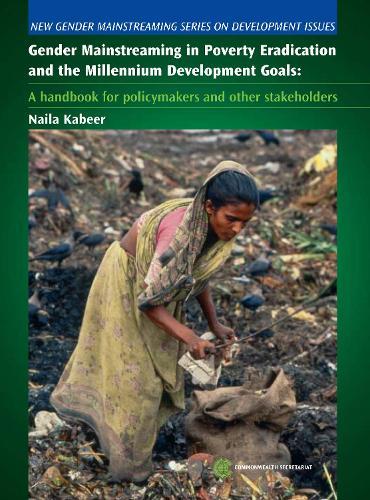
Gender Mainstreaming in Poverty Eradication and the Millennium Development Goals: A handbook for policy-makers and other stakeholders

Author:   Naila Kabeer
Publisher:   Commonwealth Secretariat
ISBN:  

9780850927528


Pages:   246
Publication Date:   01 January 2003
Format:   Paperback
Availability:   Manufactured on demand   Availability explained
We will order this item for you from a manufactured on demand supplier.

Our Price $210.10 Quantity:  
Add to Cart

Share |

Gender Mainstreaming in Poverty Eradication and the Millennium Development Goals: A handbook for policy-makers and other stakeholders


Overview

This text explores the issue of gender inequality through the lens of the Millennium Development Goals, particularly the first one of halving world poverty by 2015. The book aims to bring together arguments, findings and lessons from the development literature which are relevant to the achievement of these goals from the standpoint of gender equality. It draws out the inter-connections between production and gender (and women's critical role in straddling both) and their implications for poverty eradication strategies and the achievement of human-centred economic growth.

Full Product Details

Author:   Naila Kabeer
Publisher:   Commonwealth Secretariat
Imprint:   Commonwealth Secretariat
Dimensions:   Width: 19.00cm , Height: 1.80cm , Length: 25.00cm
Weight:   0.676kg
ISBN:  

9780850927528


ISBN 10:   0850927528
Pages:   246
Publication Date:   01 January 2003
Audience:   College/higher education ,  Professional and scholarly ,  Undergraduate ,  Postgraduate, Research & Scholarly
Format:   Paperback
Publisher's Status:   Active
Availability:   Manufactured on demand   Availability explained
We will order this item for you from a manufactured on demand supplier.

Table of Contents

Abbreviations Foreword Executive Summary 1. Gender, Poverty and Development Policy Introduction A Brief History of Poverty Reduction Policies Putting Gender on the Policy Agenda 2. Integrating Gender into Macroeconomic Analysis Introduction Gender Bias in Macroeconomic Analysis Empirical Findings Gender Equity and Economic Growth: Competing Hypothesis Conclusion 3. The Geography of Gender Inequality Introduction Institutions and Gender Inequality Regional Perspectives on Gender Equality Updating the Geography of Gender Classifying Gender Constraints Conclusion 4. Approaches to Poverty Analysis and its Gender Dimensions Introduction The Poverty Line Approach The Capabilities Approach Participatory Poverty Assessments (PPAs) Conclusion 5. Gender Inequality and Poverty Eradication: Promoting Household Livelihoods Introduction Gender Inequality and Household Poverty in South Asia Gender Inequality and Household Poverty in Sub-Saharan Africa Links Between Gender Inequality and Income Poverty: The Wider Picture Conclusion 6. Gender Equality and Human Development Outcomes: Enhancing Capabilities Introduction Gender Inequality and Human Development: The Equity Rationale Gender Inequality and Family Well-being: The Instrument Rationale Conclusion 7. Gender Equality and Women's Empowerment Introduction Conceptualising Empowerment: Agency, Resources and Achievement Access to Education and Women's Empowerment Access to Paid Work and Women's Empowerment Voice, Participation and Women's Empowerment Agency and Collective Action: Building Citizenship from the Grassroots Conclusion 8. Gender Equality and Women's Empowerment Introduction Gender Equality and Economic Growth: Synergy or Trade-off? Poverty Reduction Strategy papers (PRSPs): A Gender Audit Gender-responsive Budget (GRB) Analysis Mainstreaming Gender in Policy-making Institutions Mobilising around Gender Equity Goals: Building active Citizenship Conclusion Select Bibliography Glossary

Reviews

A gender perspective means recognising that women stand at the crossroads between production and reproduction, between economic activity and the care of human beings, and therefore between economic growth and human development. They are workers in both spheres - those most responsible and therefore with most at stake, those who suffer most when the two spheres meet at cross-purposes, and those most sensitive to the need for better integration between the two. Gita Sen


"""A gender perspective means recognising that women stand at the crossroads between production and reproduction, between economic activity and the care of human beings, and therefore between economic growth and human development. They are workers in both spheres - those most responsible and therefore with most at stake, those who suffer most when the two spheres meet at cross-purposes, and those most sensitive to the need for better integration between the two."" Gita Sen"


""A gender perspective means recognising that women stand at the crossroads between production and reproduction, between economic activity and the care of human beings, and therefore between economic growth and human development. They are workers in both spheres - those most responsible and therefore with most at stake, those who suffer most when the two spheres meet at cross-purposes, and those most sensitive to the need for better integration between the two."" Gita Sen


Author Information

Naila Kabeer is a social economist and Professorial Fellow at the Institute of Development Studies, University of Sussex, United Kingdom.

Tab Content 6

Author Website:  

Countries Available

All regions
Latest Reading Guide

NOV RG 20252


Shopping Cart
Your cart is empty
Shopping cart
Mailing List