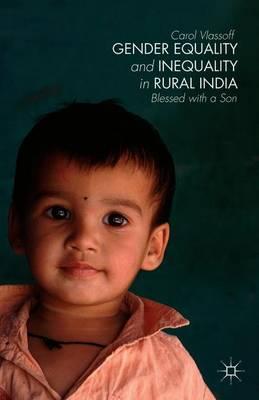
Full Product Details
Author: C. Vlassoff
Publisher: Palgrave Macmillan
Imprint: Palgrave Macmillan
Dimensions:
Width: 14.00cm
, Height: 1.40cm
, Length: 21.60cm
Weight: 3.894kg
ISBN: 9781137374929
ISBN 10: 1137374926
Pages: 204
Publication Date: 11 December 2013
Audience:
Professional and scholarly
,
Professional & Vocational
Format: Hardback
Publisher's Status: Active
Availability: In Print

This item will be ordered in for you from one of our suppliers. Upon receipt, we will promptly dispatch it out to you. For in store availability, please contact us.
Reviews
This book is an insightful study of women's empowerment and reproductive health in rural India in the context of economic change - moving beyond simplistic conventional wisdom that education alone will empower women. Vlassoff uses an innovative longitudinal design, with rigorous demographic and epidemiological analyses, to study the driving forces of son preference and how son preference ultimately shapes women's empowerment and reproductive health, illustrating 'how to do field work' for future generations of development scholars. - K.S. Mohindra, Globalization and Health Equity Research Unit, Institute of Population Health, University of Ottawa, Canada While much related research attention has been on the stronger and stubborn son preference trends in urban and rapidly developing India, Vlassoff lays out the resilient son-preference in reproductive choice in rural Maharashtra. Her strength is her robust village data spanning over three decades for exploring demographic and anthropological issues. The deft analyses of change and continuity in gender inequality, despite gender empowerment laws, holds value for social scientists as well as policy makers. - Tulsi Patel, Professor of Sociology, Delhi School of Economics, University of Delhi, India
""This book is an insightful study of women's empowerment and reproductive health in rural India in the context of economic change - moving beyond simplistic conventional wisdom that education alone will empower women. Vlassoff uses an innovative longitudinal design, with rigorous demographic and epidemiological analyses, to study the driving forces of son preference and how son preference ultimately shapes women's empowerment and reproductive health, illustrating 'how to do field work' for future generations of development scholars."" - K.S. Mohindra, Globalization and Health Equity Research Unit, Institute of Population Health, University of Ottawa, Canada ""While much related research attention has been on the stronger and stubborn son preference trends in urban and rapidly developing India, Vlassoff lays out the resilient son-preference in reproductive choice in rural Maharashtra. Her strength is her robust village data spanning over three decades for exploring demographicand anthropological issues. The deft analyses of change and continuity in gender inequality, despite gender empowerment laws, holds value for social scientists as well as policy makers."" - Tulsi Patel, Professor of Sociology, Delhi School of Economics, University of Delhi, India
Author Information
Carol Vlassoff is an Adjunct Faculty Member at the University of Ottawa, Canada.