Overview
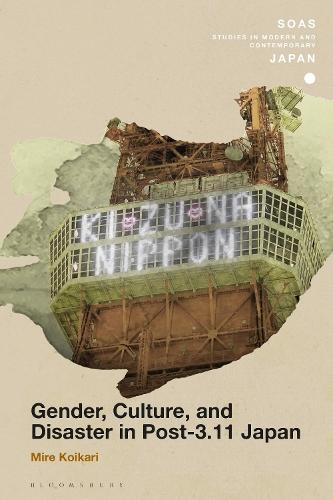
The Great East Japan Disaster – a compound catastrophe of earthquake, tsunami, and nuclear meltdown that began on March 11, 2011 – has ushered in a new era of cultural production dominated by discussions on safety and security, risk and vulnerability, and recovery and refortification. Gender, Culture, and Disaster in Post-3.11 Japan re-frames post-disaster national reconstruction as a social project imbued with dynamics of gender, race, and empire and in doing so Mire Koikari offers an innovative approach to resilience building in contemporary Japan. From juvenile literature to civic manuals to policy statements, Koikari examines a vast array of primary sources to demonstrate how femininity and masculinity, readiness and preparedness, militarism and humanitarianism, and nationalism and transnationalism inform cultural formation and transformation triggered by the unprecedented crisis. Interdisciplinary in its orientation, the book reveals how militarism, neoliberalism, and neoconservatism drive Japan’s resilience building while calling attention to historical precedents and transnational connections that animate the ongoing mobilization toward safety and security. An important contribution to studies of gender and Japan, the book is essential reading for all those wishing to understand local and global politics of precarity and its proposed solutions amid the rising tide of pandemics, ecological hazards, industrial disasters, and humanitarian crises.
Full Product Details
Author: Mire Koikari (University of Hawaii, USA)
Publisher: Bloomsbury Publishing PLC
Imprint: Bloomsbury Academic
Dimensions:
Width: 15.40cm
, Height: 1.60cm
, Length: 23.20cm
Weight: 0.320kg
ISBN: 9781350212992
ISBN 10: 1350212997
Pages: 210
Publication Date: 21 April 2022
Audience:
College/higher education
,
Tertiary & Higher Education
Format: Paperback
Publisher's Status: Active
Availability: Manufactured on demand

We will order this item for you from a manufactured on demand supplier.
Reviews
An absolutely compelling book that takes us through Japan's post-disaster generative project, as men sought to make the nation manly again, women took charge of domestic securitization, and children were taught to be resilient in a neoliberal reality. It is rendered all the more fascinating as the reader's mind inevitably turns to the recent COVID-19 epidemiological disaster in an added cross-temporal comparison. * Koichi Nakano, Dean and Professor of Political Science, Sophia University, Japan * Koikari's superb analysis exposes the politics fueling Japan's post-3.11 resilience culture, unpacking conservative ideologies of gender and nation in cheerful tales of kizuna (bonds) and good will projects. Fast-paced, fearless, and rich in archival research, Gender, Culture and Disaster in Post-3.11 Japan reveals the agendas animating the common sense of disaster preparedness. * Jan Bardsley, Professor Emerita of Asian Studies, University of North Carolina Chapel Hill, USA * The book is recommended for those interested in exploring the connection of gender and disasters, as well as nationalism in Asia and the Pacific. Far from being neutral, resilience policies can result in the transformation of attitudes and mindsets of the population, as Koikari's insightful book shows for the Japanese case. * Kult_Online *
An absolutely compelling book that takes us through Japan's post-disaster generative project, as men sought to make the nation manly again, women took charge of domestic securitization, and children were taught to be resilient in a neoliberal reality. It is rendered all the more fascinating as the reader's mind inevitably turns to the recent COVID-19 epidemiological disaster in an added cross-temporal comparison. * Koichi Nakano, Dean and Professor of Political Science, Sophia University, Japan * Koikari's superb analysis exposes the politics fueling Japan's post-3.11 resilience culture, unpacking conservative ideologies of gender and nation in cheerful tales of kizuna (bonds) and good will projects. Fast-paced, fearless, and rich in archival research, Gender, Culture and Disaster in Post-3.11 Japan reveals the agendas animating the common sense of disaster preparedness. * Jan Bardsley, Professor Emerita of Asian Studies, University of North Carolina Chapel Hill, USA *
I am unable to do justice to the plethora of curious, fascinating, and disturbing details that Koikari provides in her cogent and enlightening study. Gender, Culture, and Disaster in Post-3.11 Japan is infinitely readable without compromising scholarly rigor. Useful for researchers and instructors (especially as a strong example of critical reading in the field of cultural studies), this work is a must-read for anyone interested in contemporary Japan and the concerning trends of the neoliberal, neonationalist re-visioning of Japan in the aftermath of the 2011 Triple Disaster. * Journal of Asian Studies * I thoroughly re-commend this carefully researched and thought- fully descriptive book dealing with the aftermath of environmental and human-induced disaster. Koikari offers an astute discussion that ultimately results in a better understanding of the cultural and social mileu underlying the Japan of today. * H-Net Reviews * The book is recommended for those interested in exploring the connection of gender and disasters, as well as nationalism in Asia and the Pacific. Far from being neutral, resilience policies can result in the transformation of attitudes and mindsets of the population, as Koikari's insightful book shows for the Japanese case. * Kult_Online * An absolutely compelling book that takes us through Japan's post-disaster generative project, as men sought to make the nation manly again, women took charge of domestic securitization, and children were taught to be resilient in a neoliberal reality. It is rendered all the more fascinating as the reader's mind inevitably turns to the recent COVID-19 epidemiological disaster in an added cross-temporal comparison. * Koichi Nakano, Dean and Professor of Political Science, Sophia University, Japan * Koikari's superb analysis exposes the politics fueling Japan's post-3.11 resilience culture, unpacking conservative ideologies of gender and nation in cheerful tales of kizuna (bonds) and good will projects. Fast-paced, fearless, and rich in archival research, Gender, Culture and Disaster in Post-3.11 Japan reveals the agendas animating the common sense of disaster preparedness. * Jan Bardsley, Professor Emerita of Asian Studies, University of North Carolina Chapel Hill, USA *
Author Information
Mire Koikari is Professor of Women's Studies at University of Hawaii, USA. She is the author of Cold War Encounters in US-Occupied Okinawa: Women, Militarized Domesticity, and Transnationalism in East Asia (2015) and Pedagogy of Democracy: Feminism and the Cold War in the US Occupation of Japan (2009).