Overview
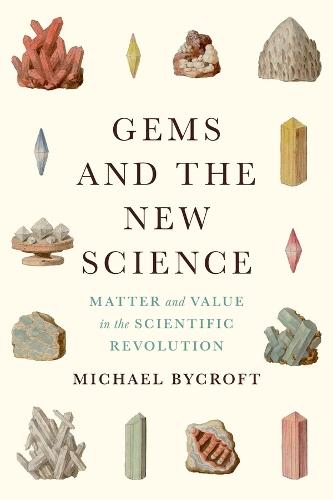
The first book-length history of gems in early modern science offers a thought-provoking new take on the Scientific Revolution. In Gems and the New Science, Michael Bycroft argues that gems were connected to major developments in the ""new science"" between the sixteenth and nineteenth centuries. As he explains, precious and semi-precious stones were at the center of dramatic shifts in natural knowledge in early modern Europe. They were used to investigate luminescence, electricity, combustion, chemical composition, and more. They were collected by naturalists, measured by mathematicians, and rubbed, burned, and dissolved by experimental philosophers. This led to the demise of the traditional way of classifying gems—which grouped them by transparency, color, and locality—and a turn to density, refraction, chemistry, and crystallography as more reliable guides for sorting these substances. The science of gems shows that material evaluation was as important as material production in the history of science. It also shows the value of seeing science as the product of the interaction between different material worlds. The book begins by bringing these insights to bear on five themes of the Scientific Revolution. Each of the subsequent chapters deals with a major episode in early modern science, from the expansion of natural history in the sixteenth century to the emergence of applied science early in the nineteenth century. This important work is not only the first book-length history of the science of gems but also a fresh interpretation of the Scientific Revolution and an argument for a new form of materialism about science.
Full Product Details
Author: Michael Bycroft
Publisher: The University of Chicago Press
Imprint: University of Chicago Press
Weight: 0.454kg
ISBN: 9780226644608
ISBN 10: 022664460
Pages: 336
Publication Date: 24 February 2026
Audience:
College/higher education
,
Postgraduate, Research & Scholarly
Format: Hardback
Publisher's Status: Forthcoming
Availability: Awaiting stock

Reviews
“In his comprehensive and magisterial account, Bycroft offers a powerful argument that gems were at the heart of the development of modern science. Gems and the New Science persuasively shows how precious stones spurred the comparative analysis and evaluative judgment of materials, facilitating the cooperation of different artisanal communities of expertise in the process. Revising current interpretations of materialism, this incisive book offers a bold and ingenious theoretical intervention into debates about the production and evaluation of knowledge claims in the Scientific Revolution.” -- Dániel Margócsy, author of “Commercial Visions: Science, Trade, and Visual Culture in the Dutch Golden Age”
“In his comprehensive and magisterial account, Bycroft offers a powerful argument that gems were at the heart of the development of modern science. Gems and the New Science persuasively shows how precious stones spurred the comparative analysis and evaluative judgment of materials, facilitating the cooperation of different artisanal communities of expertise in the process. Revising current interpretations of materialism, this incisive book offers a bold and ingenious theoretical intervention into debates about the production and evaluation of knowledge claims in the Scientific Revolution.” -- Dániel Margócsy, author of “Commercial Visions: Science, Trade, and Visual Culture in the Dutch Golden Age” “Gems—sparking, brilliant, and colorful—were central to the early modern world. Training his eye on gem cutters, merchants, chemists, and experimental philosophers, Bycroft shows how their hands and minds interacted to shape the science of gems in Europe between 1500 and 1800. As brilliant and multifaceted as the gems, Bycroft’s book uses the category of gems to show that science is always as much about evaluation as it is about production and that science remains only one way of judging value among many.” -- Sven Dupré, coeditor of “Gems in the Early Modern World: Materials, Knowledge, and Global Trade, 1450–1800”
“In his comprehensive and magisterial account, Bycroft offers a powerful argument that gems were at the heart of the development of modern science. Gems and the New Science persuasively shows how precious stones spurred the comparative analysis and evaluative judgment of materials, facilitating the cooperation of different artisanal communities of expertise in the process. Revising current interpretations of materialism, this incisive book offers a bold and ingenious theoretical intervention into debates about the production and evaluation of knowledge claims in the Scientific Revolution.” -- Dániel Margócsy, author of “Commercial Visions: Science, Trade, and Visual Culture in the Dutch Golden Age” “Gems—sparking, brilliant, and colorful—were central to the early modern world. Training his eye on gem cutters, merchants, chemists, and experimental philosophers, Bycroft shows how their hands and minds interacted to shape the science of gems in Europe between 1500 and 1800. As brilliant and multifaceted as the gems, Bycroft’s book uses the category of gems to show that science is always as much about evaluation as it is about production and that science remains only one way of judging value among many.” -- Sven Dupré, coeditor of “Gems in the Early Modern World: Materials, Knowledge, and Global Trade, 1450–1800” “Gems and the New Science is an indispensable companion for anyone looking to understand the historical development of the science of gemstones between the European Renaissance and the early nineteenth century. Bycroft has written a book that is meticulously researched, erudite, and unpredictable in the best of ways. The introduction of original concepts such as transmaterialism and the centrality given to material evaluation offer potential for future research that attempts to look at histories of science in relationship to physical objects. Gems and the New Science is an ambitious work that not only offers a better understanding of how gemstones have been understood historically by scientists, jewelers, and cutters, but also manages to convince the reader of the important role played by this process of understanding in the development of European, post-Aristotelean science.” -- Tijl Vanneste, author of “Blood, Sweat and Earth: The Struggle for Control over the World’s Diamonds Throughout History”
Author Information
Michael Bycroft is associate professor in the history of science and technology at the University of Warwick. He is the coeditor of Gems in the Early Modern World: Materials, Knowledge, and Global Trade, 1450–1800.