Awards
- Winner of Pulitzer Prize General Non-Fiction Category 1970
- Winner of Pulitzer Prize General Non-Fiction Category 1970.
Overview
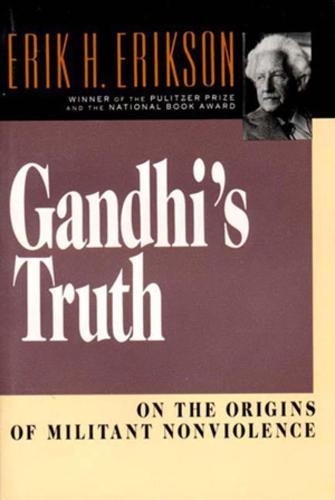
In this study of Mahatma Gandhi, psychoanalyst Erik H. Erikson explores how Gandhi succeeded in mobilizing the Indian people both spiritually and politically as he became the revolutionary innovator of militant non-violence and India became the motherland of large-scale civil disobedience.
Full Product Details
Author: Erik H. Erikson
Publisher: WW Norton & Co
Imprint: WW Norton & Co
Edition: New edition
Dimensions:
Width: 14.20cm
, Height: 3.00cm
, Length: 20.80cm
Weight: 0.602kg
ISBN: 9780393310344
ISBN 10: 0393310345
Pages: 476
Publication Date: 17 April 1993
Audience:
College/higher education
,
Professional and scholarly
,
Undergraduate
,
Postgraduate, Research & Scholarly
Format: Paperback
Publisher's Status: Active
Availability: Out of stock

The supplier is temporarily out of stock of this item. It will be ordered for you on backorder and shipped when it becomes available.
Reviews
"""Profound and enlightening... Expands our grasp of some of the ultimate questions of our time."" -- Robert Jay Lifton - The American Scholar ""It is the triumph of Erikson's book that in uncovering the inner sources of Gandhi's power it does not dissolve but deepens his inherent moral ambiguity... [This] penetrating book ... deepens out understanding not only of the inward sources of personal greatness but those, as well, of its self-defeat."" -- Clifford Geertz - New York Review of Books ""Gandhi's Truth, even more brilliantly than its predecessor, Young Man Luther, shows that psychoanalytic theory, in the hands of an interpreter both resourceful and wise, can immeasurably enrich the study of 'great lives' and of much else besides... [The book's] richness and almost inexhaustible suggestiveness ... cannot be conveyed in a summary."" -- Christopher Lasch - New York Times Book Review"
In this lengthy study of Gandhi's advance from his Bania childhood to the assumption of all-Indian Mahatmaship, Erik H. Erikson draws together some threads from his earlier and influential psychoanalytic works. He focuses on a little-known incident when Gandhi, then 48, and leading a strike in Ahmedabad, first used the technique of fasting. But in leading up to and in moving away from Ahmedabad, Erikson touches many other bases. As a student of human growth, he analyzes the illusion within Gandhi of his parents, of Hindu ethics, of Indian lifestyles, and of a uniquely personal vision - all of which underlay the Gandhian doctrine of Satyagraha, or militant nonviolence. Erikson discusses also the methodology of psychohistory, which he first attempted in his widely-acclaimed Young Man Luther. Though in a sense a sequel to that work, the present book is less orthodox as either straight biography or psychoanalytic case history. It is immensely diffuse and meandering, in places as hard to follow as an analysand's monologue. Erikson never convinces the reader of the central importance of Ahmedabad Event in Gandhi's life. Nor does he clarify the significance of some other recognized turning points. Despite his own well-known preoccupation with the search for identity, he fails to explain why the young Gandhi, on being kicked off a whites-only first class carriage in South Africa, so swiftly found his mission. Still, the book does convey the complex texture of a charismatic personality. And it contains a masterly essay on the complementary nature of Gandhian and Freudian insights, both of which Erikson endorses. Suggestive and difficult, this book will reward the patience of the reader interested in the potential of a psychoanalytic understanding of history. (Kirkus Reviews)
Gandhi's Truth, even more brilliantly than its predecessor, Young Man Luther, shows that psychoanalytic theory, in the hands of an interpreter both resourceful and wise, can immeasurably enrich the study of 'great lives' and of much else besides. . . . [The book's] richness and almost inexhaustible suggestiveness . . . cannot be conveyed in a summary. -- Christopher Lasch
Gandhi's Truth, even more brilliantly than its predecessor, Young Man Luther, shows that psychoanalytic theory, in the hands of an interpreter both resourceful and wise, can immeasurably enrich the study of 'great lives' and of much else besides. . . . [The book's] richness and almost inexhaustible suggestiveness . . . cannot be conveyed in a summary.--Christopher Lasch
Author Information
A winner of the Pulitzer Prize and the National Book Award, Erik H. Erikson was renowned worldwide as teacher, clinician, and theorist in the field of psychoanalysis and human development.