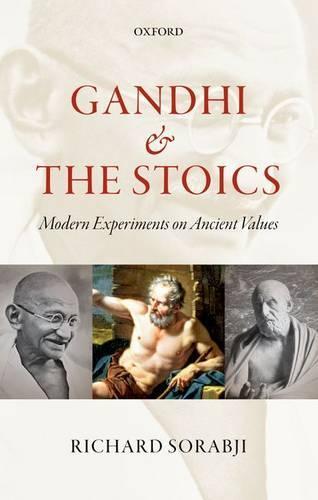
Full Product Details
Author: Richard Sorabji (Wolfson College, Oxford)
Publisher: Oxford University Press
Imprint: Oxford University Press
Dimensions:
Width: 14.20cm
, Height: 1.30cm
, Length: 21.70cm
Weight: 0.292kg
ISBN: 9780198708667
ISBN 10: 0198708661
Pages: 240
Publication Date: 08 December 2016
Audience:
College/higher education
,
Postgraduate, Research & Scholarly
,
Undergraduate
Format: Paperback
Publisher's Status: Active
Availability: To order

Stock availability from the supplier is unknown. We will order it for you and ship this item to you once it is received by us.
Reviews
`Richard Sorabji offers us a way to think about Gandhi's nonviolence in a philosophically complex way that also places the Mahatma in a much broader historical canvas, one that includes not only Stocisim and ancient philosophy in general, but also early Christianity and its 'recovery' by the Mahatma's correspondent, Tolstoy. The dialogue that Gandhi and the Stoics creates between these great and otherwise disconnected movements provides an immense pleasure to the reader. Suddenly we are able to exit the narrow compass of Indian nationalism, within which Gandhi tends to be squeezed by academics, and consider his career from a number of fresh perspectives. ' Faisal Devji, St. Antony's College, University of Oxford `By looking at Gandhi from an unusual comparative perspective, Sorabji skillfully highlights several unexplored aspects and perplexities of Gandhi's moral thought. His book makes a truly original contribution to the growing philosophical literature on Gandhi. ' Bhikhu Parekh, University of Westminster
Richard Sorabji offers us a way to think about Gandhi's nonviolence in a philosophically complex way that also places the Mahatma in a much broader historical canvas, one that includes not only Stocisim and ancient philosophy in general, but also early Christianity and its 'recovery' by the Mahatma's correspondent, Tolstoy. The dialogue that Gandhi and the Stoics creates between these great and otherwise disconnected movements provides an immense pleasure to the reader. Suddenly we are able to exit the narrow compass of Indian nationalism, within which Gandhi tends to be squeezed by academics, and consider his career from a number of fresh perspectives. Faisal Devji, St. Antony's College, University of Oxford By looking at Gandhi from an unusual comparative perspective, Sorabji skillfully highlights several unexplored aspects and perplexities of Gandhi's moral thought. His book makes a truly original contribution to the growing philosophical literature on Gandhi. Bhikhu Parekh, University of Westminster
By looking at Gandhi from an unusual comparative perspective, Sorabji skillfully highlights several unexplored aspects and perplexities of Gandhi's moral thought. His book makes a truly original contribution to the growing philosophical literature on Gandhi. * Bhikhu Parekh, University of Westminster * Richard Sorabji offers us a way to think about Gandhi's nonviolence in a philosophically complex way that also places the Mahatma in a much broader historical canvas, one that includes not only Stocisim and ancient philosophy in general, but also early Christianity and its 'recovery' by the Mahatma's correspondent, Tolstoy. The dialogue that Gandhi and the Stoics creates between these great and otherwise disconnected movements provides an immense pleasure to the reader. Suddenly we are able to exit the narrow compass of Indian nationalism, within which Gandhi tends to be squeezed by academics, and consider his career from a number of fresh perspectives. * Faisal Devji, St. Antony's College, University of Oxford *
Author Information
Richard Sorabji is author or editor of over 100 books in the History of Philosophy. Three authored books deal with the nature of the physical universe (Necessity, Cause and Blame; Time, Creation and the Continuum; Matter, Space and Motion). Four deal with Mind and Morals (Animal Minds and Human Morals; Emotion and Peace of Mind; Aristotle on Memory; Self: Individuality, Life and Death). He has written a biography, Opening Doors, of the pioneer lawyer, Cornelia Sorabji. His next book will be Moral Conscience through the Ages. He is Honorary Fellow of Wolfson College, Oxford; Fellow and Emeritus Professor of King's College, London; former Director of the Institute of Classical Studies, London, 1991-6; former President of the Aristotelian Society, 1985-6; and former Gresham Professor of Rhetoric 2000-2003.