Overview
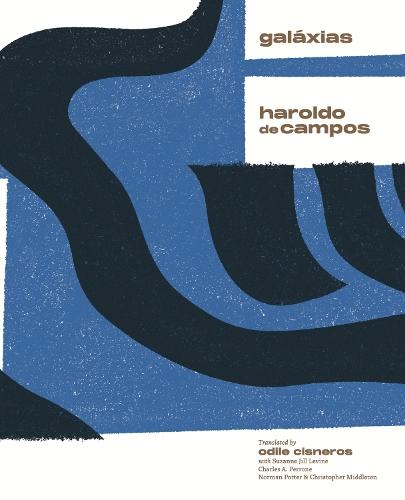
Begun in 1963 and only published in its final form in 1984, galáxias is a sui generis work. As Haroldo de Campos himself wrote: ""An audiovideotext, a videotextgame, the galáxias situate themselves on the border between prose and poetry. In this kaleidoscopic book, there’s an epic, narrative gesture—mini-stories that come together and dissolve like the 'suspense' of a detective novel … but the image remains, the vision or calling of the epiphanic."" A series of 50 “galactic cantos”—in homage to both Dante and Pound— de Campos likewise follows James Joyce’s cue in conceiving of galáxias as a “defense and illustration” of the Portuguese language and its poetic possibilities. The text incorporates literary allusion, citation, and words and phrases in at least a dozen languages, making galáxias a formidable experiment in polyglot poetry. Galáxias charts the literal and literary journeys de Campos undertook from the early 1950s on. Arguably his chief poetic accomplishment, galáxias is also a landmark in world avant-garde poetics, now appearing in the first English translation.
Full Product Details
Author: Haroldo de Campos ,
Odile Cisneros ,
Suzanne Jill Levine ,
Charles Perrone
Publisher: Ugly Duckling Presse
Imprint: Ugly Duckling Presse
Dimensions:
Width: 19.10cm
, Height: 1.30cm
, Length: 23.50cm
Weight: 0.420kg
ISBN: 9781946433763
ISBN 10: 1946433764
Publication Date: 01 November 2025
Format: Paperback
Publisher's Status: Active
Availability: In Print

This item will be ordered in for you from one of our suppliers. Upon receipt, we will promptly dispatch it out to you. For in store availability, please contact us.
Reviews
Haroldo de Campos’s epic and epiphanic galáxias finds the poetic in prose and the narrative in poetry, demonstrating again why he was one of the liveliest and most original poets of his generation in Brazil or elsewhere. Like 100 mini-kaleidoscopes, or travel stories, or “videotextgames,” to echo de Campos, galáxias anticipates the best of our current social media world but with an unmatched vision and verve. -- John Keene The important Brazilian poet-translator-theorist Haroldo de Campos’s book-length poem galáxias (1963-84) is surely one of the great poems of the second half of the twentieth-century—a postmodern “concrete prose” response to Campos’s modernist master Ezra Pound. Its 50 “galactic” cantos, each one part lyric, part narrative, rich in allusive material and multilingual phrasing, comprise a dense network of poetic effects, even as they also tell a buried story about Haroldo’s travels in unknown lands. Translating the galáxias, with their elaborate word play and complex echo structure would seem almost impossible. But Odile Cisneros has done it and done it beautifully. She recreates Haroldo’s rhythm, his assonance and rhyme effects, his etymological play, so as to allow the Anglophone reader to understand the poem’s majesty. And Cisneros provides the scholarly apparatus necessary to understand the deep structure of these strange and original cantos. A brilliant translation of a brilliant work, Cisneros’s galáxias is a major literary event. -- Marjorie Perloff, author of Unoriginal Genius Haroldo de Campos’s galáxias is a masterpiece of Latin American literature that challenges the logic of mastery. With its punctuation-less, pun-heavy, and polyrhythmic expanses of playfully philosophical text, galáxias works both as the deconstruction of the cybernetic poetics of the Brazilian concretismo a young Campos helped define and as its ultimate unfolding. Campos embraces the translingual as a mode of becoming in the borderlands of poetry and prose as “a bioscriptural pulsion in galactic expansion.” Odile Cisneros’s long-awaited translation is stunning in its balance of rigor and play, embodying the complicity of the “transcreation” Campos famously theorized and practiced while vividly rendering his neologistic flow and oracular/auricular force as well as the synesthetic music of “dream writing in bittertongue to survive your dead buriedtongue.” -- Urayoán Noel
Author Information
Haroldo de Campos played a pivotal role not only in Brazilian and Latin American culture, but also in the avant-garde at large. Born and raised in São Paulo, Brazil, Campos was barely in his twenties when he founded the concrete poetry movement alongside his brother Augusto de Campos and their friend Décio Pignatari, thus revolutionizing poetry and placing Brazil on the map of literary experimentalism for the first time. Over the years, his writing evolved in different directions, including the experimental prose of Galáxias. Parallel to his creative efforts, Campos republished long-forgotten poets, such as the Romantic Joaquim de Sousândrade and the modernist Oswald de Andrade. With Augusto and Décio, he translated modernist and world literature including Joyce, Mayakovski, Pound, medieval troubadours, Dante, Chinese classical poetry, Japanese Noh plays, Goethe, Mallarmé, Biblical texts, and Homer, among others. Campos produced a complex oeuvre of extreme global and temporal breadth gathered in more than 30 single-authored and collaborative volumes. He was admired by international figures such as Octavio Paz, Guillermo Cabrera Infante, Roman Jakobson, Umberto Eco, and Jacques Derrida. Campos received numerous prestigious distinctions, including the Jabuti Prize (Brazil), the Octavio Paz Prize (México), the Chevalier de l’Ordre des Palmes Académiques (France), the Prix Roger Caillois (France), and an honorary doctorate from Université de Montréal (Canada). Odile Cisneros is a poetry scholar and translator with interests in Latin American avant-gardes, contemporary Brazilian poetry, concrete poetry, ecopoetics, and literary translation. She coedited Novas: Selected Writings of Haroldo de Campos and has translated the work of Jaroslav Seifert, Régis Bonvicino, and Sérgio Medeiros, among others. Her translations were included in the Oxford Book of Latin American Poetry. She created and manages the website ecopoesia.com. Her work has been funded by Mexico’s Conaculta, the Canadian Social Sciences and Humanities Research Council, the Banff Centre for the Arts, and Centro de Referência Haroldo de Campos-Casa das Rosas. She teaches at the University of Alberta and in 2020 she was visiting professor at the Federal University of Santa Catarina, in Brazil. The translator of over 40 books of major Latin American writers of the 20th century, Suzanne Jill Levine's critical works include Manuel Puig and the Spider Woman: His Life and Fictions (FSG) and The Subversive Scribe: Translating Latin American Fiction. A Guggenheim Fellow, her many national and international honors include a lifetime achievement award from PEN. Her rendition of Julio Cortázar’s All Fire the Fire has recently been reissued by New Directions, and her latest is Guadalupe Nettel’s Bezoar and Other Unsettling Stories for Seven Stories Press. She is Professor Emerita (UCSB) and lives in Santa Barbara. Charles A. Perrone is Professor Emeritus in the Department of Spanish & Portuguese Studies at the University of Florida. In retirement he lives in Santa Cruz, CA, where he pursues creative writing (mostly lyric), reviews world literature, and continues to translate, principally poetry. His latest single-author book of criticism was Brazil, Lyric, and the Americas. In the 1980s he attended the seminars of Haroldo de Campos at the University of Texas. Christopher Middleton (1926-2015), born in Cornwall, England, was a poet and translator, especially of German literature. He studied at Merton College, Oxford and held academic positions at the University of Zürich and King’s College London before becoming Professor of Germanic Languages at the University of Texas, Austin. He translated Robert Walser, Nietzsche, Hölderlin, Goethe, Gert Hofmann, receiving the Geoffrey Faber Memorial Prize and the Schlegel-Tieck Prize for translation. His Collected Poems appeared in 2008. Middleton died on 29 November 2015. Norman Maurice Potter was a Brazilian translator and academic. In the 1950s, he taught English language and literature at the State University in São José do Rio Preto and the Mackenzie Institute in São Paulo. After the Brazilian military coup of 1964, he moved to the United States to teach at institutions such as the University of Texas. At Texas, he met and collaborated with Christopher Middleton when Haroldo de Campos was visiting professor there in the 1970s. He earned a doctorate from the University of Minnesota in 1981 with a dissertation titled “A construção do espaço narrativo no romance brasileiro moderno (1902-1938)” [The Construction of Narrative Space in the Modern Brazilian Novel (1902-1938)”]. He subsequently relocated to São Paulo.