Overview
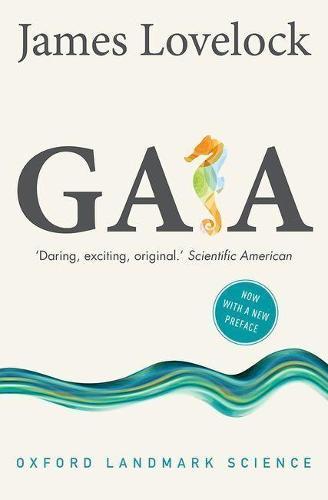
In this classic work that continues to inspire many readers, Jim Lovelock puts forward his idea that the Earth functions as a single organism. Written for non-scientists, Gaia is a journey through time and space in search of evidence in support of a radically different model of our planet. In contrast to conventional belief that life is passive in the face of threats to its existence, the book explores the hypothesis that the Earth's living matter influences air, ocean, and rock to form a complex, self-regulating system that has the capacity to keep the Earth a fit place for life. Since Gaia was first published, Jim Lovelock's hypothesis has become a hotly debated topic in scientific circles. In a new Preface to this edition, he outlines his view of the present state of the debate. Oxford Landmark Science books are 'must-read' classics of modern science writing which have crystallised big ideas, and shaped the way we think.
Full Product Details
Author: James Lovelock (Independent scientist, environmentalist, and futurist)
Publisher: Oxford University Press
Imprint: Oxford University Press
Dimensions:
Width: 12.90cm
, Height: 1.00cm
, Length: 19.50cm
Weight: 0.136kg
ISBN: 9780198784883
ISBN 10: 0198784880
Pages: 176
Publication Date: 28 April 2016
Audience:
General/trade
,
General
Format: Paperback
Publisher's Status: Active
Availability: Available To Order

We have confirmation that this item is in stock with the supplier. It will be ordered in for you and dispatched immediately.
Reviews
Daring, exciting, original. Scientific American Jim Lovelock, a man as inventive and ingenious as he is lively and unorthodox, places a daring hypothesis before the general reader, a kind of geochemical myth for our time. [His book] is the exciting personal argument of an original thinker caught in wonder. It wins and repays attention. Scientific American Lovelock writes beautifully. A book that is both original and well written is indeed a bonus. Only a genius thinks of the obvious, and Lovelock deserves to be described as a genius. New Scientist The breath-taking sweep of his central idea - that the earth is a living, self-regulating organism - poses the most dramatic challenger to scientists, politicians, and environmentalists. Jonathon Porritt
`Daring, exciting, original.' -- Scientific American`Jim Lovelock, a man as inventive and ingenious as he is lively and unorthodox, places a daring hypothesis before the general reader, a kind of geochemical myth for our time.. [His book] is the exciting personal argument of an original thinker caught in wonder. It wins and repays attention.' -- Scientific American`Lovelock writes beautifully. A book that is both original and well written is indeed a bonus. Only a genius thinks of the obvious, and Lovelock deserves to be described as a genius.' -- New Scientist`The breath-taking sweep of his central idea - that the earth is a living, self-regulating organism - poses the most dramatic challenge to scientists, politicians, and environmentalists.' -- Jonathon Porritt
Author Information
James Lovelock is the originator of the Gaia Hypothesis (now Gaia Theory). His books include Gaia: a new look at life on Earth (OUP, 1979); The Ages of Gaia (WW Norton, 1988); Gaia: the practical science of planetary medicine (Gaia Books, 1991), and The Revenge of Gaia (Allen Lane/Penguin 2006). He was elected a Fellow of the Royal Society in 1974 and in 1975 received the Tswett Medal for Chromatography. Earlier he received a CIBA Foundation Prize for research into ageing. In 1980 he received the American Chemical Society's award for Chromatography and in 1986 the Silver Medal and Prize of the Plymouth Marine Laboratory. In 1988 he was a recipient of the Norbert Gerbier Prize of the World Meteorological Organization, and in 1990 was awarded the first Amsterdam Prize for the Environment by the Royal Netherlands Academy of Arts and Sciences. In 1996 he received the Volvo Prize for the Environment and in 1997 the Blue Planet Prize.