|
|
|||
|
||||
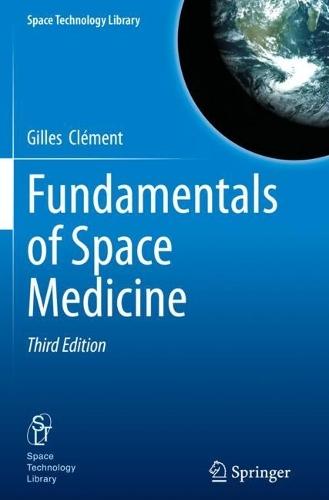
OverviewFull Product DetailsAuthor: Gilles ClémentPublisher: Springer-Verlag New York Inc. Imprint: Springer-Verlag New York Inc. Edition: Third Edition 2025 ISBN: 9781071644249ISBN 10: 1071644246 Pages: 467 Publication Date: 29 March 2026 Audience: Professional and scholarly , Professional & Vocational Format: Paperback Publisher's Status: Active Availability: Manufactured on demand We will order this item for you from a manufactured on demand supplier. Table of ContentsChapter 1: Introduction to space life sciences.- Chapter 2: Space biology.- Chapter 3: The neuro-sensory system in space.- Chapter 4: The cardio-vascular system in space.- Chapter 5: The musculo-skeletal system in space.- Chapter 6: The brain in space.- Chapter 7: Psychological issues of spaceflight.- Chapter 8: Operational space medicine.- Chapter 9: Life support systems.- Chapter 10: An investigator’s guide.ReviewsAuthor InformationDr. Gilles Clément received Doctoral Degrees in Neurobiology from the University of Lyon in 1981 and in Natural Science from the University of Paris in 1986. He is conducting space research in collaboration with the COMETE laboratory at the University of Caen-Normandy in France and the Neuroscience Laboratory at the NASA Johnson Space Center in Houston, Texas. Research in neurosciences has been his primary focus with experiments flown on Salyut, Mir, 44 Space Shuttle missions, and 67 Expeditions on the International Space Station. His research focuses on the effects of weightlessness on human posture, eye movements, spatial orientation, and cognition. Dr. Clément is the author of more than 200 publications in scientific journals and four books on the topics of space biology, space physiology, space medicine, and artificial gravity. To date, Dr. Clément has gathered data on more than 240 astronauts and cosmonauts before, during, and after 110 space missions; and on 377 volunteers on board NASA and CNES aircraft during more than 4,000 parabolic maneuvers. In 2023, Dr. Clément received the NASA Silver Snoopy Award, the Astronauts’ Personal Achievement Award “in appreciation for professionalism, dedication and outstanding support that greatly enhanced space flight safety and mission success.” In 2024, he received the NASA Exceptional Scientific Achievement Medal “for exceptional scientific achievements addressing the spectrum of physiological adaptations associated with human space flight.” Tab Content 6Author Website:Countries AvailableAll regions |
||||