Overview
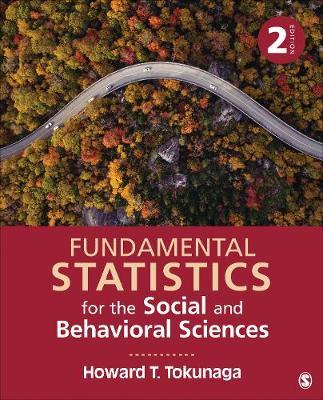
The Second Edition includes a new chapter on regression; covers how collected data can be organized, presented and summarized; the process of conducting statistical analyses to test research questions, hypotheses, and issues/controversies; and examines statistical procedures used in research situations that vary in the number of independent variables in the study. Every chapter includes learning checks, such as review questions and summary boxes, to reinforce the content students just learned, and exercises at the end of every chapter help assess their knowledge. FREE SAGE edge online resources, including SAGE original videos with Howard T. Tokunaga, makes learning easier for students.
Full Product Details
Author: Howard T. Tokunaga
Publisher: SAGE Publications Inc
Imprint: SAGE Publications Inc
Edition: 2nd Revised edition
Weight: 1.390kg
ISBN: 9781506377483
ISBN 10: 1506377483
Pages: 712
Publication Date: 17 January 2019
Audience:
College/higher education
,
Tertiary & Higher Education
Format: Paperback
Publisher's Status: Active
Availability: Out of stock

The supplier is temporarily out of stock of this item. It will be ordered for you on backorder and shipped when it becomes available.
Reviews
I think this is some of the best explanation for these concepts that I have read. -- JoEllen Pederson I appreciate the structures, the simplicity in the language, the clarity and the ability to pull material that is appropriate for college level courses. -- Cristine Rego I think the author has a strong command and grasp of the material which he demonstrates by providing students with a multitude of examples and formulas that are easy to understand and broken down into digestible portions for students to absorb at their own pace. The writing style of the author is excellent...He spends a significant amount of time decomposing and deconstructing complex ideas related to the measures of central tendency for both novice and expert students of statistics in a user-friendly and approachable tone. -- Keith Feigenson The writing style is nice and easy to follow. -- Timothy Victor
The writing style is nice and easy to follow. -- Timothy Victor I think the author has a strong command and grasp of the material which he demonstrates by providing students with a multitude of examples and formulas that are easy to understand and broken down into digestible portions for students to absorb at their own pace. The writing style of the author is excellent...He spends a significant amount of time decomposing and deconstructing complex ideas related to the measures of central tendency for both novice and expert students of statistics in a user-friendly and approachable tone. -- Keith Feigenson I appreciate the structures, the simplicity in the language, the clarity and the ability to pull material that is appropriate for college level courses. -- Cristine Rego I think this is some of the best explanation for these concepts that I have read. -- JoEllen Pederson
The writing style is nice and easy to follow. -- Timothy Victor I think the author has a strong command and grasp of the material which he demonstrates by providing students with a multitude of examples and formulas that are easy to understand and broken down into digestible portions for students to absorb at their own pace. The writing style of the author is excellent...He spends a significant amount of time decomposing and deconstructing complex ideas related to the measures of central tendency for both novice and expert students of statistics in a user-friendly and approachable tone. -- Keith Feigenson I appreciate the structures, the simplicity in the language, the clarity and the ability to pull material that is appropriate for college level courses. -- Cristine Rego I think this is some of the best explanation for these concepts that I have read. -- JoEllen Pederson
Author Information
Howard Tokunaga is Professor of Psychology at San Jose State University, where he serves as Coordinator of the MS Program in Industrial/Organizational (I/O) Psychology and teaches undergraduate and graduate courses in statistics, research methods, and I/O psychology. He received his bachelor’s degree in psychology at UC Santa Cruz and his Ph.D. in psychology at UC Berkeley. In addition to his teaching, he has consulted with a number of public sector and private sector organizations on a wide variety of management and human resource issues. He is author of Moving from IBM SPSS to R and RStudio: A Statistics Companion, and co-author (with G. Keppel) of Introduction to Design and Analysis: A Student’s Handbook. In his spare time, he enjoys the outdoors, museums, live theater, and being physically, socially, and politically active as possible.