Overview
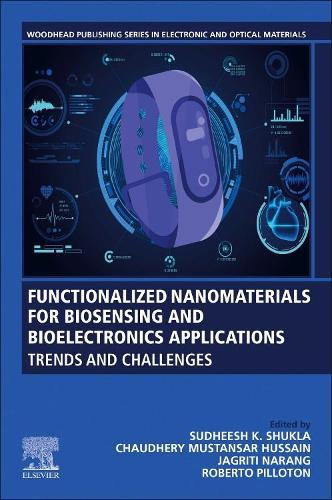
Functionalized Nanomaterials for Biosensing and Bioelectronics Applications: Trends and Challenges describes current and future opportunities for integrating the unique properties of two-dimensional nanomaterials with bioelectronic interfaces. Sections focus on background information and fundamental concepts, review the available functionalized nanomaterials and their properties, explore the integration of functionalized nanomaterials with bioelectronics, including available fabrication and characterization methods, electrical behavior at the interface, and design and synthesis guidelines, and review examples of microsystems where functionalized nanomaterials are being integrated with bioelectronics. This book is suitable for researchers and practitioners in academia and R&D working in materials science and engineering, analytical chemistry, and related fields.
Full Product Details
Author: Sudheesh K. Shukla ,
Chaudhery Mustansar Hussain (Adjunct Professor and Director of Chemistry & EVSC Labs, Department of Chemistry and Environmental Science, New Jersey Institute of Technology (NJIT), Newark, NJ, USA) ,
Jagriti Narang (Department of Biotechnology, School of Chemical and Life Science, Jamia Hamdard University, New Delhi, India) ,
Roberto Pilloton (Institute of Crystallography, National Research Council (CNR-IC), Rome, Italy)
Publisher: Elsevier Science Publishing Co Inc
Imprint: Woodhead Publishing
Weight: 1.000kg
ISBN: 9780128238295
ISBN 10: 0128238291
Pages: 376
Publication Date: 13 June 2024
Audience:
Professional and scholarly
,
Professional & Vocational
Format: Paperback
Publisher's Status: Active
Availability: Manufactured on demand

We will order this item for you from a manufactured on demand supplier.
Author Information
Sudheesh K. Shukla is a researcher with the Department of Chemical Sciences, University of Johannesburg, Doornfontein Campus, Johannesburg, South Africa; and Associate Professor at the School of Chemical Engineering and Physical Sciences, Lovely Professional University, Phagwara, India. His research involves real-time analysis of biochemical markers for personalized healthcare and environmental monitoring. Chaudhery Mustansar Hussain is an adjunct professor and lab director in the Department of Chemistry & Environmental Sciences at the New Jersey Institute of Technology (NJIT), United States. His research is focused on sustainability, nanotechnology & advanced materials, environmental management, analytical chemistry, and other various industries. Dr. Hussain is the author of numerous papers in peer-reviewed journals as well as a prolific author and editor of several books, including scientific monographs and handbooks in his research areas. He has published with ELSEVIER, American Chemical Society, Royal Society of Chemistry, John Wiley & Sons, CRC Press, and Springer. Jagriti Narang is an Assistant Professor at the Department of Biotechnology, Jamia Hamdard, New Delhi, and has work experience of more than 10 years. She has authored or coauthored many research papers in international peer-reviewed journals. She has edited four books and written several chapters. She is a committee member of many international conferences and is a member of Material Research Society of India and Society of Biological Chemistry. She is also an editor and peer reviewer of many international journals and has presented her papers on several international platforms. Dr. Narang has done extensive work on the fabrication of various biosensors for the diagnostic applications. She has proposed some laboratory models that can be converted into commercial monitoring device. Since 1986, Roberto Pilloton has been at the forefront of advancing bioanalytical methods through the innovative use of electrochemical biosensors, particularly in the domains of food, clinical, and environmental analysis. His distinguished career includes roles as a senior researcher at two of Italy's leading research institutes: the ENEA ""Italian Institute of Sustainable Development"" and the CNR ""National Research Council."" In addition to his impactful research contributions, Pilloton has imparted his knowledge as an adjunct professor, specializing in Environmental Bioanalytical Chemistry, across several esteemed Italian universities and research institutes. His dedication to education is further demonstrated by his role as a mentor, guiding students in the development of master's and PhD theses, as well as mentoring national and international fellows. Pilloton's global influence extends beyond academic circles, as he has served as a visiting scientist in prominent institutions in Paris, Stuttgart, Nice, Braunschweig, Lund, Izmir, Ceske Budejovice, and Karaikudi. Moreover, he has played a pivotal role in shaping the landscape of international conferences on biosensors, having chaired or been a member of the scientific committee. From 2015 to 2018, Pilloton served as the elected vice president of the ""International Association on Environmental Analytical Chemistry"" (IAEAC). Currently, he holds the esteemed position of Editor-in-Chief of the International Journal of Environmental Analytical Chemistry at Taylor and Francis, and he is a valuable member of the editorial boards of two MDPI journals: Sensors and Biosensors.