Full Product Details
Author: Loren B. Mead ,
J. Michael Martinez
Publisher: Bloomsbury Publishing PLC
Imprint: Bloomsbury Academic
ISBN: 9798881803544
Pages: 328
Publication Date: 30 April 2026
Audience:
Professional and scholarly
,
Professional & Vocational
Format: Hardback
Publisher's Status: Active
Availability: Manufactured on demand

We will order this item for you from a manufactured on demand supplier.
Reviews
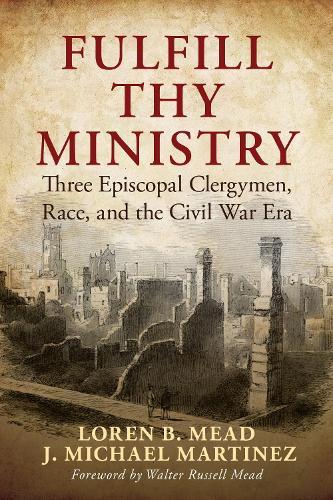
The late Rev. Loren B. Mead and the historian J. Michael Martinez have given us an invaluable composite biography of three white Episcopal priests from South Carolina who, after their faithful service to the Confederate military and ordination in the Protestant Episcopal Church, followed distinctly different paths in their post-emancipation responses to the new racial order and the ways and means of white supremacy. Looking from afar, we might expect three sons of the ruling class to share a rigorous fealty to anti-Black positions in the tumultuous era of Reconstruction in South Carolina. However, as the authors’ careful portraiture reveals, the priests—Peter Fayssoux Stevens, Anthony Toomer Porter, and William Porcher DuBose—varied in religious temperament and commitment to the pastoral mission of the Episcopal Church, which in turn led to important differences in their thoughts and actions regarding freed people’s place in the post-war ecclesial and social order. Even if none challenged the most basic expectations of white racial supremacy, only DuBose held strong to an anti-Black vision of the Church. The more grounded ministries of Stevens and Porter, in varying degrees, either sought room in the Church for Black South Carolinians or endeavored to uplift freed people through education. Each biography of an understudied figure is valuable in itself, but the inspired decision to bind them into one book yields the important insight that, even among white conservatives and in the most conservative of white Southern churches, the emerging racial order of the New South was not foreordained and did not go unchallenged. -- Woody Register * Francis S. Houghteling Professor of American History, Director, Roberson Project on Slavery, Race, & Reconciliation, The University of the South * Fulfill Thy Ministry tells the intertwined stories of three white Episcopal priests-Peter Fayssoux Stevens, Anthony Toomer Porter, and William Porcher DuBose-who came of age in antebellum South Carolina and who served with the Confederate army, but whose ministries following the Civil War reflected markedly divergent understandings of the place of the newly emancipated within their church. To account for this divergence, Mead and Martinez carefully examine the details of each man’s life and of the places where each was called to minister. What emerges is a study that adds much-needed nuance to our understanding of the Episcopal Church in the South during and after Reconstruction. -- Rev. Dr. N. Brooks Graebner * Historiographer of the Episcopal Diocese of North Carolina * Fulfill Thy Ministry is a deeply researched, well-organized, clearly written, and thoughtful treatment of religion and race in the Civil War Era South. Mead and Martinez humanize their subjects, treat them fairly, and evaluate them honestly in an engaging blend of description and analysis. Their book adds significantly to Episcopal studies and Southern post-Civil War literature. -- Stephen L. Longenecker * Professor of History Emeritus, Bridgewater College * Fulfill Thy Ministry provides portraits of three white southern men who answered the call to ordained ministry following their service as soldiers in the Confederate Army of the South. Facing the devastated natural and economic landscapes of their home and local communities, each priest also had to confront the interior landscape of his own upbringing in service to his emancipated neighbors as siblings in Christ. Authors (the late) Reverend Loren B. Mead and J. Michael Martinez provide in-depth accounts of the twists and turns of each man’s journey and how to varying degrees, in different manners, each struggled to overcome his formation in the womb of southern white supremacy. Fulfill Thy Ministry is an excellent and provocative resource for a more layered understanding of the insidious power of white supremacy to compromise even those dedicated to serving the Gospel of Jesus Christ. -- The Rt. Rev. Anne E. Hodges-Copple * Bishop Suffragan of the Diocese of North Carolina (Resigned) * Loren Mead and J. Michael Martinez’s introduction to three clergymen of the Confederacy and Reconstruction illumines the struggles of any who find their lives upended and their faith challenged. Their work provides a mirror and a reality test for all who live in a rapidly changing world. -- Rev. Dr. Francis H. Wade * Rector Emeritus of St. Alban’s Episcopal Church, Washington, DC *
Author Information
Loren B. Mead (1930-2018) was a prominent Episcopal priest and prolific author and a native of Florence, South Carolina. J. Michael Martinez is the author or editor of 20 books on American history and law including the Rowman & Littlefield titles A Long Dark Night: Race in America from Jim Crow to World War II (2016), Terrorist Attacks on American Soil: From the Civil War Era to the Present (2012), Coming for to Carry Me Home: Race in America from Abolitionism to Jim Crow (2011), and Carpetbaggers, Cavalry, and the Ku Klux, Klan: Exposing the Invisible Empire during Reconstruction (2007). He teaches political science at Georgia Gwinnett College in Lawrenceville, Georgia.