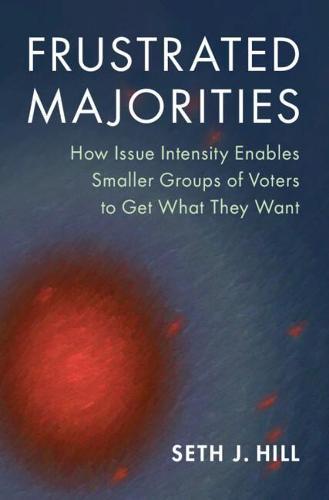
Frustrated Majorities: How Issue Intensity Enables Smaller Groups of Voters to Get What They Want

Author:   Seth J. Hill (University of California, San Diego)
Publisher:   Cambridge University Press
Edition:   New edition
ISBN:  

9781009167680


Pages:   258
Publication Date:   22 September 2022
Format:   Hardback
Availability:   Manufactured on demand   Availability explained
We will order this item for you from a manufactured on demand supplier.

Our Price $214.76 Quantity:  
Add to Cart

Share |

Frustrated Majorities: How Issue Intensity Enables Smaller Groups of Voters to Get What They Want


Overview

Full Product Details

Author:   Seth J. Hill (University of California, San Diego)
Publisher:   Cambridge University Press
Imprint:   Cambridge University Press
Edition:   New edition
Dimensions:   Width: 15.80cm , Height: 2.10cm , Length: 23.60cm
Weight:   0.537kg
ISBN:  

9781009167680


ISBN 10:   1009167685
Pages:   258
Publication Date:   22 September 2022
Audience:   General/trade ,  General
Format:   Hardback
Publisher's Status:   Active
Availability:   Manufactured on demand   Availability explained
We will order this item for you from a manufactured on demand supplier.

Table of Contents

Part I. Frustrated Majorities, Issue Intensity, and Political Action: 1. Majoritarian politics and minority interests; 2. The political science of representation, elections, and intensity; Part II. Argument: An Intensity Theory of Electoral Competition: 3. Sketching a theory of intensity and electoral competition; 4. Theory and model results: Issue intensity, costly action, and minority representation; 5. Model extensions: Varying size of the minority, the free-rider problem, and social welfare; Part III. Evidence: Empirical Patterns and Intensity Theory: 6. Introduction to empirical evidence; 7. Politicians side with intense minorities; 8. Issues of intensity explain vote choice; 9. Opening avenues of costly action: Institutional change to costs of campaign contributions; 10. Closing avenues of costly action: Reform to primary elections; Part IV. Conclusions: 11. Conclusion: Implications for representative democracy and the study of politics; Part V. Appendix A. Mathematical model of intensity and electoral competition; B. Formalities of Chapter 5; C. Supplementary information for Chapter 8; D. Supplementary information for Chapter 9; E. Supplementary information for Chapter 10; Bibliography; Index.

Reviews

'In an engaging use of rational choice, Hill applies formal theory to public opinion and electoral data to produce what he calls a 'theory of intensity.' This theory argues that political minorities who care intensely about a policy issue are apt to prevail over an apathetic majority. Though the central idea is not new in political science and, in recent years, has been a subject of growing concern, Hill's work suggests why it reflects the choices of both voters and politicians. … Recommended.' M. Price, Choice '… this ambitious book is well worth reading. The model is carefully constructed and tightly argued, and the subsequent empirical chapters provide supportive evidence.' Kirby Goidel, Perspectives on Politics 'Challenging our preconceptions is what a good book does, and on this count Seth Hill's book unquestionably succeeds.' Kirby Goidel, Nicholas T. Davis and Keith Gåddie, Perspectives on Politics


Author Information

Seth J. Hill is Professor of Political Science at the University of California San Diego.

Tab Content 6

Author Website:  

Countries Available

All regions
Latest Reading Guide

NOV RG 20252


Shopping Cart
Your cart is empty
Shopping cart
Mailing List