Overview
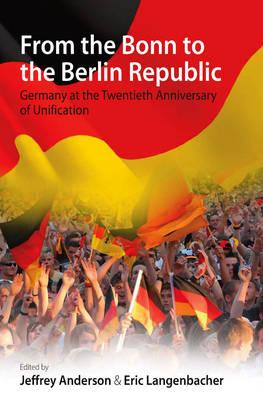
The fall of the Berlin Wall and the unification of East and West Germany in 1989/90 were events of world-historical significance. The twentieth anniversary of this juncture represents an excellent opportunity to reflect upon the evolution of the new Berlin Republic. Given the on-going significance of the country for theory and concept–building in many disciplines, an in-depth examination of the case is essential. In this volume, unique in its focus on all aspects of contemporary Germany - culture, historiography, society, politics and the economy - top scholars offer their assessments of the country’s performance in these and other areas and analyze the successes and continued challenges.
Full Product Details
Author: Jeffrey Anderson ,
Eric Langenbacher
Publisher: Berghahn Books
Imprint: Berghahn Books
Dimensions:
Width: 15.20cm
, Height: 2.20cm
, Length: 22.90cm
Weight: 0.581kg
ISBN: 9780857452214
ISBN 10: 0857452215
Pages: 416
Publication Date: 01 November 2010
Audience:
Professional and scholarly
,
Professional & Vocational
Format: Paperback
Publisher's Status: Active
Availability: Awaiting stock

The supplier is currently out of stock of this item. It will be ordered for you and placed on backorder. Once it does come back in stock, we will ship it out for you.
Reviews
<em>Altogether the contributions make for informative reading. The volume poses clear questions about the state of inner-German unity, and about the extent to which globalization, Europeanization, and the Cold War have changed the country.</em> <b>- </b> <strong>German Studies Review</strong></p> <em>.. .the specific topics addressed in the individual contributions are handled and presented with admirable fluency, and none of the chapters appear out of place, overly niched, or superfluous to the overall narrative being communicated...In comparison to a number of recently published monograph histories of the Berlin Republic, this detailed volume contains much more specific material on the themes it addresses. While it thus cannot replace the narrative history of those monographs, it will function very well as a complement for advanced students and researchers alike. </em> <b>- German History</b></p>
Altogether the contributions make for informative reading. The volume poses clear questions about the state of inner-German unity, and about the extent to which globalization, Europeanization, and the Cold War have changed the country. * German Studies Review ...the specific topics addressed in the individual contributions are handled and presented with admirable fluency, and none of the chapters appear out of place, overly niched, or superfluous to the overall narrative being communicated...In comparison to a number of recently published monograph histories of the Berlin Republic, this detailed volume contains much more specific material on the themes it addresses. While it thus cannot replace the narrative history of those monographs, it will function very well as a complement for advanced students and researchers alike. * German History
Altogether the contributions make for informative reading. The volume poses clear questions about the state of inner-German unity, and about the extent to which globalization, Europeanization, and the Cold War have changed the country. . German Studies Review .. .the specific topics addressed in the individual contributions are handled and presented with admirable fluency, and none of the chapters appear out of place, overly niched, or superfluous to the overall narrative being communicated...In comparison to a number of recently published monograph histories of the Berlin Republic, this detailed volume contains much more specific material on the themes it addresses. While it thus cannot replace the narrative history of those monographs, it will function very well as a complement for advanced students and researchers alike.. German History
Author Information
Jeffrey Anderson is Graf Goltz Professor of Government and Director of the BMW Center for German and European Studies, Georgetown University. He is an expert in European politics, with special emphasis on the European Union and postwar German politics and foreign policy. Recent publications include, The End of the West? Crisis and Change in the Atlantic Order (edited with G. John Ikenberry and Thomas Risse, Cornell University Press, 2008); German Unification and the Union of Europe: The Domestic Politics of Integration Policy (Cambridge University Press, 1999).