|
|
|||
|
||||
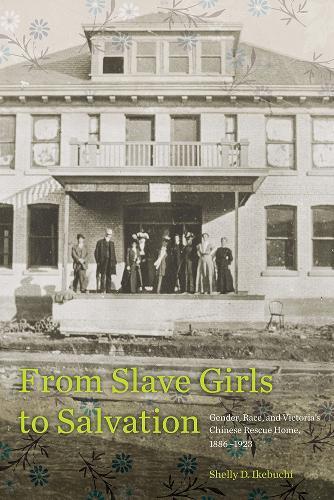
OverviewFrom its origins as a project to rescue Chinese prostitutes and slave girls from a life of supposed depravity the Chinese Rescue Home became a feature of the moral and racial landscape of Victoria – a place where the Methodist Women's Missionary Society attempted to reform Chinese and Japanese girls and women, in part by teaching them domestic skills meant to ease their integration into Western society. Between 1886 and 1923, over four hundred Chinese and Japanese women sheltered in the home. Yet, despite the significance of this iconic institution, little has been written on its history. From Slave Girls to Salvation draws on a rich collection of archival materials to uncover the organizational hierarchies, as well as the religious and racial tropes, which permeated the home. In doing so, it expands our understanding of the complex interplay of gender, race, and class in BC during this time period. Full Product DetailsAuthor: Shelly D. IkebuchiPublisher: University of British Columbia Press Imprint: University of British Columbia Press Weight: 0.380kg ISBN: 9780774830577ISBN 10: 0774830573 Pages: 264 Publication Date: 01 July 2016 Audience: General/trade , General Format: Paperback Publisher's Status: Active Availability: In Print This item will be ordered in for you from one of our suppliers. Upon receipt, we will promptly dispatch it out to you. For in store availability, please contact us. Table of ContentsIntroduction: Breaking Ground 1 Foundations of Stone: Victoria and the Chinese Rescue Home 2 Pillars of Domesticity and the “Chinese Problem” 3 Crossing the Threshold: Interrogating the Space and Place of Victoria’s Chinese Rescue Home 4 Outside the Walls of the Home: Men, Marriage, and Morals in the Public Arena 5 Roofs, Rafters, and Refuge: The State, Race, and Child Custody Conclusion: Race, Gender, and National Imaginings Notes; Appendix: Sources and Methodology; Bibliography; IndexReviewsAuthor InformationShelly D. Ikebuchi researches and teaches in Sociology at Okanagan College, Kelowna, BC. Her research takes a postcolonial/poststructural approach in order to examine the social, legal, and historical intersections of gender, race, and religion in a Canadian context Tab Content 6Author Website:Countries AvailableAll regions |
||||