Overview
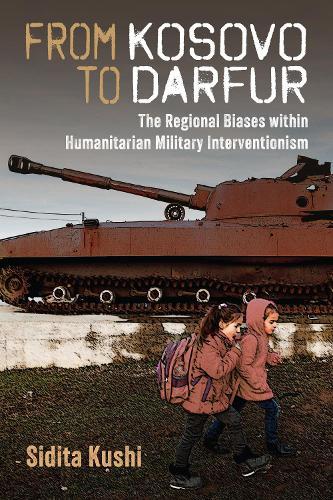
Why are some violent crises more likely to prompt humanitarian military interventions than others? Conventional wisdom says that humanitarian military interventions occur due to national interests, shared values and norms, or economic benefits for the interveners. Yet neither of these factors can fully explain the selectivity of such interventions. The international community continues to ignore the decades-long suffering in Darfur, often dismisses the genocidal policies within Myanmar, and even perpetuates the suffering in contemporary Yemen, while undertaking humanitarian-laden missions in Libya, Syria, and the Balkans. Using in-depth case studies and new data on all post–Cold War internal armed conflicts matched to third-party responses, From Kosovo to Darfur offers the first regionally sensitive analysis of humanitarian military intervention since the end of the Cold War. It shows that international military interventions in the context of acute humanitarian crises are driven by different pathways within the Western versus the non-Western world and fueled by elite perceptions of the crisis, making interventions closer to the geographic and cultural West most probable and most intense. As our international community becomes increasingly interdependent and aware of human suffering across borders, From Kosovo to Darfur points to new pathways of conflict trajectories and reveals vital implications for leaders, scholars, and nongovernmental actors advocating for or against international military intervention as a policy choice.
Full Product Details
Author: Sidita Kushi
Publisher: The University of Michigan Press
Imprint: The University of Michigan Press
ISBN: 9780472077441
ISBN 10: 0472077449
Pages: 312
Publication Date: 07 July 2025
Audience:
Professional and scholarly
,
Professional & Vocational
Format: Hardback
Publisher's Status: Active
Availability: Available To Order

We have confirmation that this item is in stock with the supplier. It will be ordered in for you and dispatched immediately.
Reviews
“From Kosovo to Darfur uses multiple methods to show that states intervene depending on whether the conflict occurs near the western neighborhood and whether it is cast as an identity-based civil war. It’s clearly organized and structured, the terminology is defined, and theoretical frameworks are cited and characterized to support the argument. This book would work well for syllabi at the undergraduate or graduate level.” “From Kosovo to Darfur works to fill a gap in existing literature on civil war and humanitarian intervention with regard to region. The strength of the book lies in its theoretical framework, and the case studies used to support the framework. It merges region with the global power hierarchy to identify areas of the world that are part of, or near, the ‘West’ in an interesting and valuable contribution to scholarship.”
“From Kosovo to Darfur uses multiple methods to show that states intervene depending on whether the conflict occurs near the western neighborhood and whether it is cast as an identity-based civil war. It’s clearly organized and structured, the terminology is defined, and theoretical frameworks are cited and characterized to support the argument. This book would work well for syllabi at the undergraduate or graduate level.” - Sarah Kreps, Cornell University “From Kosovo to Darfur works to fill a gap in existing literature on civil war and humanitarian intervention with regard to region. The strength of the book lies in its theoretical framework, and the case studies used to support the framework. It merges region with the global power hierarchy to identify areas of the world that are part of, or near, the ‘West’ in an interesting and valuable contribution to scholarship.” - Marie Olson Lounsbery, East Carolina University
Author Information
Sidita Kushi is Assistant Professor of Political Science at Mount Holyoke College.