Overview
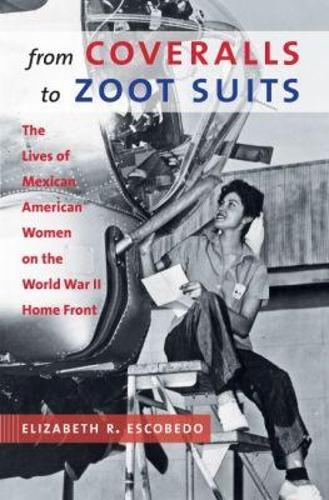
During World War II, unprecedented employment avenues opened up for women and minorities in U.S. defense industries at the same time that massive population shifts and the war challenged Americans to rethink notions of race. At this extraordinary historical moment, Mexican American women found new means to exercise control over their lives in the home, workplace, and nation. In From Coveralls to Zoot Suits, Elizabeth R. Escobedo explores how, as war workers and volunteers, dance hostesses and zoot suiters, respectable young ladies and rebellious daughters, these young women used wartime conditions to serve the United States in its time of need and to pursue their own desires. But even after the war, as Escobedo shows, Mexican American women had to continue challenging workplace inequities and confronting family and communal resistance to their broadening public presence. Highlighting seldom heard voices of the """"Greatest Generation,"""" Escobedo examines these contradictions within Mexican families and their communities, exploring the impact of youth culture, outside employment, and family relations on the lives of women whose home-front experiences and everyday life choices would fundamentally alter the history of a generation.
Full Product Details
Author: Elizabeth R. Escobedo
Publisher: The University of North Carolina Press
Imprint: The University of North Carolina Press
Dimensions:
Width: 15.80cm
, Height: 1.50cm
, Length: 23.60cm
Weight: 0.456kg
ISBN: 9781469622095
ISBN 10: 1469622092
Pages: 256
Publication Date: 28 February 2015
Audience:
College/higher education
,
Postgraduate, Research & Scholarly
Format: Paperback
Publisher's Status: Active
Availability: Manufactured on demand

We will order this item for you from a manufactured on demand supplier.
Reviews
Escobedo has produced an exemplary study, a ground-level microhistory that speaks to larger issues and would work well in both undergraduate and graduate courses.--Journal of American History Escobedo's detailed work leaves no doubt that the distinctive experiences of Mexican American women form a powerful lens through which to view U.S. history more generally, particularly the history of World War II.--American Studies Journal Escobedo's book still expands our understanding of race, community, and identity in new and important ways that speak to both the significance of the period as well as larger concepts, such as how everyday practices can also be viewed as examples of political experiences or cultural practices.--Southern California Quarterly A superbly researched and written book. . . . [Escobedo] draws heavily on oral histories and archival documents, and her use of photographs from the Los Angeles Public Library makes for an attractive presentation. . . . Highly recommended. All levels/libraries.--Choice Escobedo has written a fine addition to an ever-growing body of work on Mexican Americans during World War II, in the tradition of the culture-conscious social historians George Sanchez and, especially, Vicki Ruiz.--American Historical Review An excellent read for those wishing to understand the roles of women in the 1940s from a perspective not often revealed and how these experiences have influenced the young women of today.--Journal of Family & Consumer Sciences A rich and multifaceted view of Mexican American women's lives in Los Angeles in the 1940s and 1950s. . . . Fresh and exciting.--Women's Review of Books A solidly researched and well-written perspective.--Minnesota History [A] deft examination of the simultaneously liberating and limiting wartime experiences of Mexican American women.--Register of the Kentucky Historical Society [A] well-written, thoughtful work.--Western Historical Quarterly A significant contribution that has recovered the experiences of Mexican and Mexican American women during World War II.--H-Net Reviews Well written with an impressive use of firsthand accounts, including oral histories and interviews. . . . Escobedo does a wonderful job sifting through the evidence to bring to light a previously neglected subject. Scholars of twentieth-century American history, Mexican American history, World War II, and American race and gender will find this book valuable for its examination of how Latinas were able to maneuver through previously held biases and stereotypes in order to improve the world around them.--Southwestern Historical Quarterly
An excellent read for those wishing to understand the roles of women in the 1940s from a perspective not often revealed and how these experiences have influenced the young women of today.--Journal of Family & Consumer Sciences A rich and multifaceted view of Mexican American women's lives in Los Angeles in the 1940s and 1950s. . . . Fresh and exciting.--Women's Review of Books A solidly researched and well-written perspective.--Minnesota History A superbly researched and written book. . . . [Escobedo] draws heavily on oral histories and archival documents, and her use of photographs from the Los Angeles Public Library makes for an attractive presentation. . . . Highly recommended. All levels/libraries.--Choice [A] deft examination of the simultaneously liberating and limiting wartime experiences of Mexican American women.--Register of the Kentucky Historical Society [A] well-written, thoughtful work.--Western Historical Quarterly A significant contribution that has recovered the experiences of Mexican and Mexican American women during World War II.--H-Net Reviews Well written with an impressive use of firsthand accounts, including oral histories and interviews. . . . Escobedo does a wonderful job sifting through the evidence to bring to light a previously neglected subject. Scholars of twentieth-century American history, Mexican American history, World War II, and American race and gender will find this book valuable for its examination of how Latinas were able to maneuver through previously held biases and stereotypes in order to improve the world around them.--Southwestern Historical Quarterly Escobedo has produced an exemplary study, a ground-level microhistory that speaks to larger issues and would work well in both undergraduate and graduate courses.--Journal of American History Escobedo has written a fine addition to an ever-growing body of work on Mexican Americans during World War II, in the tradition of the culture-conscious social historians George Sanchez and, especially, Vicki Ruiz.--American Historical Review Escobedo's detailed work leaves no doubt that the distinctive experiences of Mexican American women form a powerful lens through which to view U.S. history more generally, particularly the history of World War II.--American Studies Journal Escobedo's book still expands our understanding of race, community, and identity in new and important ways that speak to both the significance of the period as well as larger concepts, such as how everyday practices can also be viewed as examples of political experiences or cultural practices.--Southern California Quarterly
[A] deft examination of the simultaneously liberating and limiting wartime experiences of Mexican American women. -- Register of the Kentucky Historical Society
Author Information
Elizabeth R. Escobedo is associate professor of history at the University of Denver, USA.