|
|
|||
|
||||
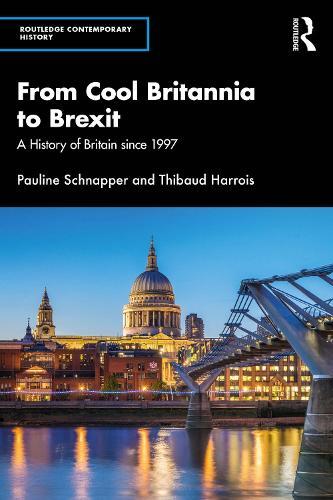
OverviewThe 2016 referendum on Brexit represents a watershed moment in the United Kingdom’s contemporary history, reflecting new divides and questioning many of the premises on which the country’s identity and position in the world had been based for almost half a century. From Cool Britannia to Brexit discusses and analyses the last three decades of British political history, looking at why Britain found itself shut out from its immediate neighbours on the continent in 2016, twenty years after the country was celebrated as a prosperous, optimistic and culturally influential 'Cool Britannia'. This book ultimately shows the limits of the Westminster model of government and the enduring inequalities that affect Britain, but also insists on the resilience of its state and institutions. This book is primarily aimed at an undergraduate and non-specialist audience. It explores the long-term political, economic and social changes which have affected the British polity in the early 21st century, which led to a dramatic decision in 2016, and in turn created more instability and political turbulence. Full Product DetailsAuthor: Pauline Schnapper , Thibaud HarroisPublisher: Taylor & Francis Ltd Imprint: Routledge Weight: 0.430kg ISBN: 9781032698656ISBN 10: 1032698659 Pages: 222 Publication Date: 30 January 2026 Audience: Professional and scholarly , Professional & Vocational Format: Paperback Publisher's Status: Active Availability: Manufactured on demand We will order this item for you from a manufactured on demand supplier. Table of ContentsIntroduction Chapter 1: The Constitution Introduction Political parties and constitutional reforms Reforming Britain’s constitution The House of Lords The Supreme Court Fixed-term Parliaments Electoral reform The Brexit referendum: a challenge to parliamentary democracy The Covid-19 crisis and the constitution Constitutional Monarchy at the end of the second Elizabethan era The monarch’s political neutrality in question The monarch’s religious role in an increasingly secular Britain Conclusion Chapter 2: Parties, Elections and Voters Introduction 1. The new party system(s) 2. The crisis of representation: how voting changed 3. Changes in parties: policies and organisation 4. New forms of participation Petitions and consultations Online campaigning Deliberative democracy Social movements Conclusion Chapter 3: The State of the Union Introduction 1. Devolution to Scotland and Wales 2. Northern Ireland 3. The 2014 Scottish independence referendum 4. The Brexit effect 5. Consequences of the Covid pandemic 6. The state of England Conclusion Chapter 4: Britain and Europe - The Road to Brexit Introduction 1. The ambiguities of New Labour Changes in rhetoric Limits to the changes 2. The rise of Euroscepticism The Conservative party in opposition The coalition government 3. The Brexit referendum The campaign Explaining the result 4. UK-EU relations after Brexit Conclusion Chapter 5: Britain in the World Introduction New Labour, old values ? The UK, NATO and the defence of Europe in the post-Cold War context The Franco-British Saint-Malo Declaration: introducing new concepts in European defence Liberal interventionism and the ‘special relationship’ with the USA The war in Kosovo and the UK’s ‘moral’ international role Reviving the ‘special relationship’ in the ‘war on terror’ The legacy of ‘Blair’s wars’ and ‘liberal conservatism’ The ‘Arab Spring’ and its aftermath No ’strategic shrinkage’: reviewing the UK’s defence and security priorities The United Kingdom and the EU’s foreign and security policy ‘Global Britain’: a redefinition of Britain’s role in the world? Conclusion Chapter 6: The Economy Introduction 1. The New Labour era The 1997 economic context New Labour’s proposals for the 1997 general election Institutional reform: the independence of the Bank of England Globalisation: a catalyst for growth Public spending and investment Tax policy and welfare reforms The Housing market boom 2. Gordon Brown’s premiership and the aftermath of the 2008 global financial crisis The global financial crisis and its impact on the British economy Economic measures Oucomes and the Brown’s legacy 3. The Conservative-led coalition government (2010-2015) and the Conservative government before the 2016 referendum Austerity policies Financial regulation and banking policies Monetary policies and interest rates Taxation policies Labour market and employment policies Housing and infrastructure policies 4. What political response to economic challenges after 2016? Trade policy and agreements Monetary policy and the control of inflation Regulatory reforms and financial services Fiscal policy and public spending Investment and productivity challenges Labour market and immigration policies Conclusion Chapter 7: A more diverse and unequal society Introduction 1. Demographic trends Population and families Social attitudes 2. Immigration and multiculturalism Attitudes towards immigrants Questioning state multiculturalism Immigration policy 3. Class and social inequalities Social classes and identity 4. Inequalities, poverty and unemployment Poverty Unemployment Public attitudes to poverty and welfare Social policies since 1997 5. The housing crisis Conclusion Chapter 8: Education Introduction 1. New Labour’s education agenda Early years and primary education Secondary education Higher education 2. Education policy and reforms under the Coalition Government Academisation and free schools Curriculum and assessment reforms Teacher training and professional development Higher education reforms 3. New challenges: education policy in the aftermath of Brexit and Covid-19 School reforms The crisis of higher education Cyber security and artificial intelligence in education Conclusion Chapter 9: Old and New Media Introduction The evolution of traditional media: the press, television and the radio The press: decline and digital transition Television: innovation and cultural change The digital switch-over The changing role of the BBC and public service broadcasting The end of impartiality: opinion channels The rise of reality TV and entertainment formats The streaming revolution and global competition Radio: challenges and adaptation Digital transformation Commercial consolidation Community radio Changing listening habits Scandals and ethics The rise of tabloid culture and ethical challenge The phone hacking scandal and the Leveson Inquiry Coverage of terrorism and minority representation Covering the royal family The 2016 referendum campaign Media impartiality and the challenge of ‘false balance’: the case of the BBC A digital battleground Conclusion Chapter 10: Cultural policy Introduction 1. The New Labour vision: Cool Britannia ? 2. The impact of austerity on the cultural sector 3. Two shocks: Brexit and Covid 4. The legacy of empire and culture wars ConclusionReviewsAuthor InformationPauline Schnapper is Professor of British Politics at Université Sorbonne Nouvelle, Paris. Her research covers in particular British European policy and post-Brexit politics. Her most recent publications include La Politique au Royaume-Uni (La Découverte, 2022) and, with Helen Drake, '""We thought we were friends!"": Franco-British bilateral diplomacy and the shock of Brexit' (Journal of Contemporary European Research, 2021). Thibaud Harrois is Senior Lecturer in British Politics at Université Sorbonne Nouvelle, Paris. His research focuses on British foreign and security policy. His latest publications include ‘The politicisation of the Common Foreign and Security Policy in the British domestic debate on Brexit: A challenge to EU–UK foreign and security cooperation’ (Contemporary British History, 2023). Tab Content 6Author Website:Countries AvailableAll regions |
||||