Overview
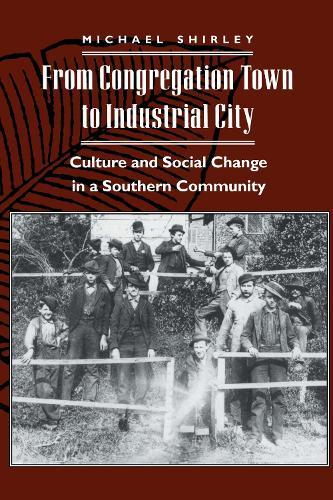
In 1835, Winston and Salem was a well-ordered, bucolic, and attractive North Carolina town. A visitor could walk up Main Street from the village square and get a sense of the quiet Moravian community that had settled here. Yet, over the next half-century, this idyllic village was to experience dramatic changes. The Industrial Revolution calls forth images of great factories, mills, and machinery; yet, the character of the Industrial Revolution went beyond mere changes in modes of production. It meant the radical transformation of economic, social, and political institutions, and the emergence of a new mindset that brought about new ways of thinking and acting. Here is the illuminating story of Winston-Salem, a community of artisans and small farmers united, as members of a religious congregation, by a single vision of life. Transformed in just a few decades from an agricultural region into the home of the smokestacks and office towers of the R.J. Reynolds Tobacco Company and the Wachovia Bank and Trust Company, the Moravian community at Salem offers an illuminating illustration of the changes that swept Southern society in the nineteenth century and the concomitant development in these communities of a new ethos. Providing a rich wealth of information about the Winston-Salem community specifically, From Congregation Town to Industrial City also significantly broadens our understanding of how wholesale changes in the nineteenth century South redefined the meaning and experience of community. For, by the end of the century, community had gained an entirely new meaning, namely as a forum in which competing individuals pursued private opportunities and interests.
Full Product Details
Author: Michael Shirley
Publisher: New York University Press
Imprint: New York University Press
Edition: New edition
Dimensions:
Width: 15.20cm
, Height: 2.20cm
, Length: 22.90cm
Weight: 0.454kg
ISBN: 9780814780862
ISBN 10: 0814780865
Pages: 338
Publication Date: 01 August 1997
Audience:
College/higher education
,
Undergraduate
,
Postgraduate, Research & Scholarly
Format: Paperback
Publisher's Status: Active
Availability: Manufactured on demand

We will order this item for you from a manufactured on demand supplier.
Reviews
(<p> A fine addition to the study of urbanization. . . . Shirley's book will appeal not only to a regional audience in the South but also to all students of the diverse American experience. )-( American Historical Review ), ()
<p> Compelling. . . . [an] important contribution to our understanding of the modernizing of America. - Journal of Interdisciplinary History ,
<p> A welcome contribution to the field of Southern labor history.
""A fine addition to the study of urbanization... Shirley's book will appeal not only to a regional audience in the South but also to all students of the diverse American experience."" --American Historical Review""Compelling... [an] important contribution to our understanding of the modernizing of America."" --Journal of Interdisciplinary History ""A welcome contribution to the field of Southern labor history."" --Journal of Social History
A fine addition to the study of urbanization... Shirley's book will appeal not only to a regional audience in the South but also to all students of the diverse American experience. --American Historical Review Compelling... [an] important contribution to our understanding of the modernizing of America. --Journal of Interdisciplinary History A welcome contribution to the field of Southern labor history. --Journal of Social History
Author Information
Michael Shirley is Senior Program Officer at the National Endowment for the Humanities in Washington, DC.