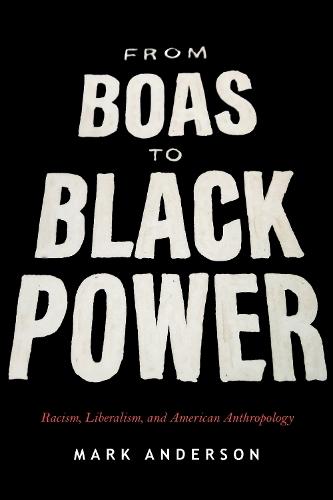
Full Product Details
Author: Mark Anderson
Publisher: Stanford University Press
Imprint: Stanford University Press
Edition: New edition
ISBN: 9781503607873
ISBN 10: 1503607879
Pages: 272
Publication Date: 14 May 2019
Audience:
Professional and scholarly
,
College/higher education
,
Professional & Vocational
,
Postgraduate, Research & Scholarly
Format: Paperback
Publisher's Status: Active
Availability: In Print

This item will be ordered in for you from one of our suppliers. Upon receipt, we will promptly dispatch it out to you. For in store availability, please contact us.
Reviews
This is an important intervention in the history of U.S. anthropology, particularly the history of anthropological debates on race, racism, and the intellectual impact of Black Power as a social movement. Mark Anderson's interrogation of the liberal anti-racism associated largely with Boasians seriously engages the critiques and alternative scholarship of William Willis, Diane Lewis, Charles & Betty Lou Valentine, and St. Clair Drake, who belonged to an earlier decolonizing generation that cleared the ground for later critical anti-racist projects. This insightful analysis un-silences significant aspects of anthropology's past and illuminates how dominant liberal modalities of anti-racism-regardless of intention-sustain the epistemic, cultural, and structural power of white supremacy, an obstacle to justice, well-being, and liberation. -- Faye V. Harrison From Boas to Black Power thoughtfully examines the contradictions and tensions of anthropology's last 100 years. Using Boasian interventions on race and culture as a valuable starting point, this important book explains how thinking about race/racism in anthropology (and in the wider public culture) pivots on various assumptions about liberalism that link race to American identity in ways that haunt the country as much as ever these days. -- John L. Jackson, Jr.
From Boas to Black Power thoughtfully examines the contradictions and tensions of anthropology's last 100 years. Using Boasian interventions on race and culture as a valuable starting point, this important book explains how thinking about race/racism in anthropology (and in the wider public culture) pivots on various assumptions about liberalism that link race to American identity in ways that haunt the country as much as ever these days. -- John L. Jackson, Jr. * University of Pennsylvania * This is an important intervention in the history of U.S. anthropology, particularly the history of anthropological debates on race, racism, and the intellectual impact of Black Power as a social movement. Mark Anderson's interrogation of the liberal anti-racism associated largely with Boasians seriously engages the critiques and alternative scholarship of William Willis, Diane Lewis, Charles & Betty Lou Valentine, and St. Clair Drake, who belonged to an earlier decolonizing generation that cleared the ground for later critical anti-racist projects. This insightful analysis un-silences significant aspects of anthropology's past and illuminates how dominant liberal modalities of anti-racism-regardless of intention-sustain the epistemic, cultural, and structural power of white supremacy, an obstacle to justice, well-being, and liberation. -- Faye V. Harrison * University of Illinois at Urbana-Champaign * What [Anderson] selects is essential, informative, and critical. His significant contribution to the history of anthropology and American liberalism is the way he combines his razor-sharp analysis of text and context and paradox and contradiction. -- Lee D. Baker * <i>Transforming Anthropology</i> *
This is an important intervention in the history of U.S. anthropology, particularly the history of anthropological debates on race, racism, and the intellectual impact of Black Power as a social movement. Mark Anderson's interrogation of the liberal anti-racism associated largely with Boasians seriously engages the critiques and alternative scholarship of William Willis, Diane Lewis, Charles & Betty Lou Valentine, and St. Clair Drake, who belonged to an earlier decolonizing generation that cleared the ground for later critical anti-racist projects. This insightful analysis un-silences significant aspects of anthropology's past and illuminates how dominant liberal modalities of anti-racism-regardless of intention-sustain the epistemic, cultural, and structural power of white supremacy, an obstacle to justice, well-being, and liberation. -- Faye V. Harrison * University of Illinois at Urbana-Champaign * From Boas to Black Power thoughtfully examines the contradictions and tensions of anthropology's last 100 years. Using Boasian interventions on race and culture as a valuable starting point, this important book explains how thinking about race/racism in anthropology (and in the wider public culture) pivots on various assumptions about liberalism that link race to American identity in ways that haunt the country as much as ever these days. -- John L. Jackson, Jr. * University of Pennsylvania *
Author Information
Mark Anderson is Associate Professor of Anthropology at University of California, Santa Cruz. He is the author of Black and Indigenous: Garifuna Activism and Consumer Culture in Honduras (2009).