Overview
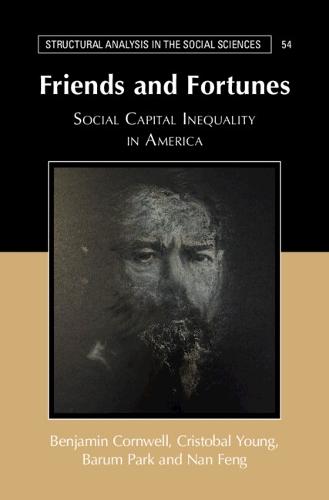
Durable social connections are priceless resources for support, companionship, and opportunity. They make life worth living. However, not everyone has equal access to these seemingly free social resources. Like many other valuable things in life, 'social capital' is both a source and a consequence of inequality throughout the population – something that reinforces the status quo and existing social hierarchies. In Friends and Fortunes, the authors painstakingly document that the distribution of social connections in American society is as stark as income inequality. Through detailed analyses and colorful real-life illustrations, they reveal how rich elites hoard both the most prized and the most deceptively frivolous social ties. Drawing on over one hundred measures of social capital from dozens of datasets and over one million people, they explain how social networks create a remarkable and omnipresent web of connections that subtly feed hidden systems of power, prestige, wealth and, ultimately, life chances.
Full Product Details
Author: Benjamin Cornwell (Cornell University, New York) ,
Cristobal Young (Cornell University, New York) ,
Barum Park (Cornell University, New York) ,
Nan Feng (New York University)
Publisher: Cambridge University Press
Imprint: Cambridge University Press
ISBN: 9781009483254
ISBN 10: 1009483250
Pages: 300
Publication Date: 30 April 2026
Audience:
College/higher education
,
Postgraduate, Research & Scholarly
Format: Hardback
Publisher's Status: Forthcoming
Availability: Not yet available, will be POD

This item is yet to be released. You can pre-order this item and we will dispatch it to you upon it's release. This is a print on demand item which is still yet to be released.
Reviews
'The authors pull back from the network details of social capital to capture two broad features across individuals, groups, and territories: (1) social connectivity is beneficial, and (2) that connectivity is concentrated, as are material resources, in the hands of a minority. In establishing a general foundation, the book should be productive as a reading for undergraduates, or a platform from which many a doctoral dissertation could launch.' Ronald Burt, University of Chicago and Bocconi University 'An exceptionally comprehensive, empirically rich examination of inequality in social connectedness in the United States. Friends and Fortunes thoroughly documents the appreciable unevenness in distributions of individual social capital indicators, including numerous personal network features and organizational affiliations. It then shows how access to these social resources differs by income and age (especially) as well as race/ethnicity and gender – thereby reinforcing rather than counteracting fault lines of material inequality.' Peter V. Marsden, Edith and Benjamin Geisinger Professor of Sociology, Harvard University 'This book offers the most comprehensive portrait to date of how social capital, the resources embedded in social ties, is distributed across the American population and how that distribution has evolved over the past half century. Bringing together an unprecedented range of data and linking classic theory to new empirical evidence, it shows that social capital is both a driver and a consequence of economic inequality, making it essential reading for scholars and students of inequality, social networks, and contemporary American society.' Filiz Garip, Princeton University
Author Information
Benjamin Cornwell served as Chair of Sociology at Cornell University. He has published two books, including Social Sequence Analysis (Cambridge, 2015) and over 70 studies on topics such as social networks and epidemiology. In 2017, the American Sociological Association awarded Cornwell the Leo Goodman Award for advances in research methods. Cristobal Young is Associate Professor of Sociology at Cornell University. He studies the social dynamics of inequality, ranging from millionaire taxes to unemployment. His methodological work centers on model uncertainty and robust results. His most recent book is Multiverse Analysis: Computational Methods for Robust Results (with Erin Cumberworth, Cambridge, 2025). Barum Park is an Assistant Professor of Sociology at Cornell University. He works on topics in political sociology, social networks, social mobility, and quantitative methods. Barum's work has appeared in American Journal of Sociology, Journal of Politics, Social Forces, Sociological Methodology, and Sociological Science, among other outlets. Nan Feng is a postdoctoral researcher at the Institute for Public Knowledge at New York University. She received a Ph.D. in sociology from Cornell University in 2024. She studies how social networks shape inequality and are shaped by inequality. Her work employs innovative quantitative approaches to study complex data structures.