Overview
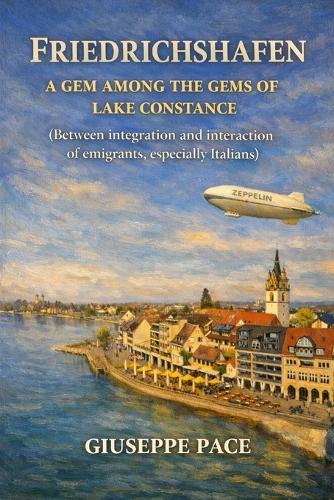
This essay, centered on the city of Friedrichshafen in Germany, is comprised of a Preface, Introduction, Prologue, and Afterword by illustrious figures such as Academician Professor N. C. Berchisan, whose contributions permeate this overview. There is a moment, on the shores of Lake Constance, when the fog of the Bodensee lifts and the Alps appear so close they seem almost tangible. In that instant, the viewer sees not just a landscape; they see a border that has become a bridge. This book was born from the need to describe what happens when human experience challenges the fixity of codes, when Friedrichshafen encounters the ""culture"" of those who have crossed the Alpine border with a suitcase full of a mindset ready for change. For decades, we have been told that culture is an invisible filter, a software that programs us from birth, making us foreigners forever. But walking the streets of Friedrichshafen, we realize that culture is not destiny: it is practice, it is action. In this journey of rediscovery, the narrative intertwines with the lives of those who have turned being an ""intellectual migrant"" into a teaching profession. Consider the figure of the author, whose educational mission transcended national borders. His dedication led him to teach, demonstrating that the laws of nature and science speak a universal language. Pace embodies Italian excellence, exported with humility and rigor, transforming his chair into a meeting place for peoples, such as the Italian and Germanic peoples in general, and Friedrichshafen in particular. He also cites its main cemetery with vita mutatur non tollitur for his sister-in-law Erika and the 96 Italian soldiers killed in the Allied bombings of 1944. If Pace took science abroad, Berchisan took the opposite path, teaching at the University of Rome ""La Sapienza"" with a master's degree in Cross-Cultural and Intercultural Studies. Although they draw on different disciplines-the natural sciences for Pace, anthropology and linguistics for Berchisan-both converge toward the same goal: to decode the human complexity of Friedrichshafen, a city described by Pace as something far beyond a tourist guide. He highlights its historical, industrial, and civic evolution, with specificities connected to those of Baden-Württemberg, the city's museums, the Zeppelin University, the German school system, and the German economy, the third world power. The modern symbol of this evolution is the Friedrichshafen Media House, the Media Palace. It is not just a glass and steel building; it is a monument to diversity and universal access to knowledge. Here, P. Freire's pedagogy is fulfilled: culture is not a commodity to be consumed, but a process of ""consciousness raising."" In the Media House, immigrants and locals sit side by side. It is the place where communication ceases to be a filter and becomes dialogue, where the ""science"" of the territory and the ""language"" of interaction become a shared heritage. The essay on Friedrichshafen proves that intelligence is not a fixed fact, but an expansion that occurs when we allow ourselves to inhabit common spaces. The Italians who chose these shores discovered that the world becomes beautiful precisely because it is colored by a variety born from the friction between the known and the unknown. Welcome to Friedrichshafen, where the world is diverse because experience has had the courage to blend and the intellect has had the audacity to recognize no boundaries.
Full Product Details
Author: Giuseppe Pace
Publisher: Independently Published
Imprint: Independently Published
Dimensions:
Width: 15.20cm
, Height: 2.00cm
, Length: 22.90cm
Weight: 0.508kg
ISBN: 9798248792320
Pages: 380
Publication Date: 17 February 2026
Audience:
General/trade
,
General
Format: Paperback
Publisher's Status: Active
Availability: Available To Order

We have confirmation that this item is in stock with the supplier. It will be ordered in for you and dispatched immediately.