Overview
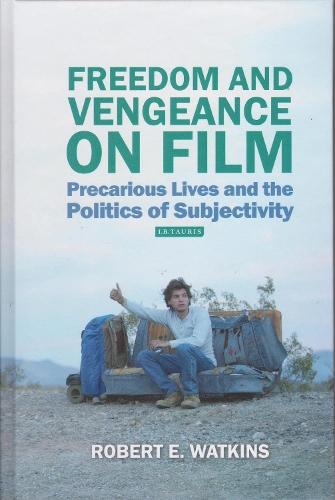
Films both reflect and construct social reality, especially in the way they employ, affirm and critique the discourses through which we grasp political life. This book examines five contemporary feature films that engage our deep attachments to two core political ideas freedom and vengeance asking: what do audiences learn about freedom and vengeance from film, and what are the political consequences of the reproduction or disruption of their meanings? Often, contemporary films represent the pursuit of freedom and revenge in a depoliticized way, erasing the precarious character of social life. Other films, however, foreground the negotiation of unchosen relations and circumstances in their drama. Films examined include Into the Wild, Mystic River, The Three Burials of Melquiades Estrada, Wendy and Lucy and Winter s Bone.""
Full Product Details
Author: Robert E. Watkins (Columbia College Chicago, USA)
Publisher: Bloomsbury Publishing PLC
Imprint: I.B. Tauris
Dimensions:
Width: 15.60cm
, Height: 1.80cm
, Length: 23.40cm
Weight: 0.413kg
ISBN: 9781784530105
ISBN 10: 1784530107
Pages: 176
Publication Date: 31 May 2016
Audience:
College/higher education
,
Postgraduate, Research & Scholarly
Format: Hardback
Publisher's Status: Active
Availability: Manufactured on demand

We will order this item for you from a manufactured on demand supplier.
Reviews
The myth of the self-reliant individual saturates US cinema, and Robert Watkins offers an incisive analysis of its effects. He shows how filmic visions of individualism ignore social dependence while legitimating domination and vengeance. Yet Watkins also reveals an alternative cinema that rejects the violence of individualism by emphasizing unchosen experiences of political vulnerability. This astute and timely book should be read by political theorists, film scholars, and anyone interested in investigating the US political imaginary. - Dr. Elisabeth Anker, Associate Professor of American Studies and Political Science, The George Washington University
The myth of the self-reliant individual saturates US cinema, and Robert Watkins offers an incisive analysis of its effects. He shows how filmic visions of individualism ignore social dependence while legitimating domination and vengeance. Yet Watkins also reveals an alternative cinema that rejects the violence of individualism by emphasizing unchosen experiences of political vulnerability. This astute and timely book should be read by political theorists, film scholars, and anyone interested in investigating the US political imaginary. - Dr. Elisabeth Anker, Associate Professor of American Studies and Political Science, The George Washington University, 'What can cinema offer political theory? And what can political theory contribute to the experience of film? Through a series of transformative readings of recent Hollywood films, American political thought, and contemporary cultural theory, Watkins discerns the threads of a new political film genre that organizes itself around the representations of precarious lives. In doing so, Watkins challenges us to rethink not only the terms of what a cultural politics may be, but also its reach, sensibilities, and limits. What one discovers in the pages of Freedom and Vengeance on Film is the centrality of spectatorship for a radical democratic politics that isn't easily persuaded by the fragile myth of American individualism and autonomous choice. More than this, Watkins's book is an exemplary instance of an ethics of paying attention to the world of appearances that imbues and surrounds our contemporary condition.'- Davide Panagia, Associate Professor of Political Science, UCLA, 'Arguing that we are not sovereign, isolated individuals, but dependent, precarious subjects, Robert Watkins aims his critical sights on the hollow idea of individualism that hovers near the heart of American liberalism. But this is not yet another abstract critique of liberal political philosophy; instead, in doing cultural politics by reading recent American film, Watkins offers a deft analysis of the powerful and abiding notions of freedom and vengeance. He thereby reveals to his readers the tangible reality of liberal practices of freedom, showing not just that sovereign individualism is a myth, but how that myth sustains itself and with what effects.' - Samuel A. Chambers, Associate Professor of Political Science, Johns Hopkins University
Author Information
Robert E. Watkins is Associate Professor of Politics and Cultural Studies at Columbia College, Chicago. He has published in, among others, the journals Political Theory, History of the Human Sciences and Perspectives on Politics.