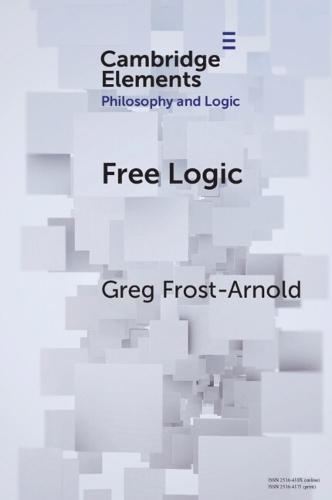
Free Logic: A Generalization

Author:   Greg Frost-Arnold (Hobart and William Smith Colleges)
Publisher:   Cambridge University Press
ISBN:  

9781009114059


Pages:   110
Publication Date:   30 January 2025
Format:   Paperback
Availability:   Manufactured on demand   Availability explained
We will order this item for you from a manufactured on demand supplier.

Our Price $46.58 Quantity:  
Add to Cart

Share |

Free Logic: A Generalization


Overview

Classical logic assumes that names are univocal: every name refers to exactly one existing individual. This Principle of Univocality has two parts: an existence assumption and a uniqueness assumption. The existence assumption holds that every name refers to at least oneindividual, and the uniqueness assumption states that every name refers to at most one individual. The various systems of free logic which have been developed and studied since the 1960s relax the existence assumption, but retain the uniqueness assumption. The present work investigates violations of both halves of the Principle of Univocality. That is, whereas the free logics developed from the 1960s are called 'free' because they are free of existential assumptions, the current Element generalizes this idea, to study logics that are free of uniqueness assumptions. We explore several versions of free logic, comparing their advantages and disadvantages. Applications of free logic to other areas of philosophy are explored.

Full Product Details

Author:   Greg Frost-Arnold (Hobart and William Smith Colleges)
Publisher:   Cambridge University Press
Imprint:   Cambridge University Press
Dimensions:   Width: 15.20cm , Height: 0.60cm , Length: 22.90cm
Weight:   0.172kg
ISBN:  

9781009114059


ISBN 10:   1009114050
Pages:   110
Publication Date:   30 January 2025
Audience:   General/trade ,  General
Format:   Paperback
Publisher's Status:   Active
Availability:   Manufactured on demand   Availability explained
We will order this item for you from a manufactured on demand supplier.

Table of Contents

1. Introduction; 2. Why free logic?; 3. Truth and models; 4. Proofs and logical consequence; 5. Costs and benefits of each system; 6. Conclusion: revisiting the motivations; References.

Reviews

Author Information

Tab Content 6

Author Website:  

Countries Available

All regions
Latest Reading Guide

NOV RG 20252


Shopping Cart
Your cart is empty
Shopping cart
Mailing List