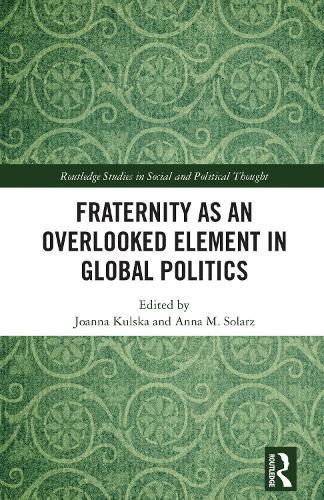
Fraternity as an Overlooked Element in Global Politics

Author:   Joanna Kulska ,  Anna M. Solarz
Publisher:   Taylor & Francis Ltd
ISBN:  

9781032966205


Pages:   286
Publication Date:   05 May 2025
Format:   Hardback
Availability:   In Print   Availability explained
This item will be ordered in for you from one of our suppliers. Upon receipt, we will promptly dispatch it out to you. For in store availability, please contact us.

Our Price $305.00 Quantity:  
Add to Cart

Share |

Fraternity as an Overlooked Element in Global Politics


Overview

Full Product Details

Author:   Joanna Kulska ,  Anna M. Solarz
Publisher:   Taylor & Francis Ltd
Imprint:   Routledge
Weight:   0.580kg
ISBN:  

9781032966205


ISBN 10:   1032966203
Pages:   286
Publication Date:   05 May 2025
Audience:   College/higher education ,  Tertiary & Higher Education
Format:   Hardback
Publisher's Status:   Active
Availability:   In Print   Availability explained
This item will be ordered in for you from one of our suppliers. Upon receipt, we will promptly dispatch it out to you. For in store availability, please contact us.

Table of Contents

Foreword. Introduction: Fraternity as an overlooked element of (global) politics. Section 1. Defining the term and the contexts Chapter 1. Between community and conflict. An attempt to reconstruct the theoretical discourse on fraternity. Chapter 2. Solidarity, fraternity, sorority: Reflections from the individualist-collectivist intercultural continuum. Chapter 3. What we owe each other: fraternity, solidarity, or mutual respect? A liberal perspective. Chapter 4. Religious reasons and democratic deliberation. A critique of exclusivist approaches in political theory. Chapter 5. “Friendship” as a political concept in Thomas Aquinas: an alternative to “fraternity”? Chapter 6. “Universal brotherhood”: a religious or secular concept? On the idea of human fraternity in Fratelli tutti and monotheistic religious traditions. Section 2. From theory to practice Chapter 7. Between rights and duties: fraternity as a post-secular concept. Chapter 8. “Spirit of Assisi”, “Fratelli tutti”, Human Fraternity. The prayer meetings for peace of the Community of Sant'Egidio in a historical perspective. Chapter 9. The “Solidarity Movement: A Polish style brotherhood. An attempt to explain the phenomenon through the prism of its religious component. Section 3. Between idea and reality Chapter 10. Brotherhood Without Brothers. Chapter 11. The Notion of 'Brotherly People' in the Service of Russian Neo-Imperialism: The Image of Ukraine and Ukrainians in Russian Strategic Documents and Security Debate after 2014. Chapter 12. Brotherhood and solidarity in Latvia: the context of history, war and migration. Section 4. Non-Western alternatives (?) Chapter 13. Branding Human Brotherhood in Saudi Arabia: Limits and Resources for Global Politics. Chapter 14. Tablighi Jamaat in Iran. Borderless Fraternity with Global Ambitions. Chapter 15. Ubuntu: African Personhood and the Reconstitution of Global Community. Afterword. Fraternity can change the world... for the better?

Reviews

Author Information

Joanna Kulska is an associate professor at the Institute of Political Science and Administration of University of Opole and the director of the trinational Polish-German-French Europa Master Program. She was a fellow of the John Paul II Foundation in Rome and the Kosciuszko Foundation in New York, conducting research at the University of Chicago, and a guest professor at the Institute of Political Science at the University of Mainz. She is interested in international cultural relations, the changing role of religious factor in international relations and IR, church-state relations in Europe, civil society, peace and conflict issues, and evolution of contemporary diplomacy. Anna M. Solarz is a lecturer in the Department of Regional and Global Studies at the Faculty of Political Science and International Studies, University of Warsaw. She conducted her research, among others, at the Mershon Center for International Security Studies at Ohio State University, USA. Her field of interest is the intersection of religion, culture and politics in international relations, with a focus on theoretical aspects of research on religion in IR, regional studies, the Middle East and Israel's foreign policy, as well as the Holy See as an international actor.

Tab Content 6

Author Website:  

Countries Available

All regions
Latest Reading Guide

April RG 26_2


Shopping Cart
Your cart is empty
Shopping cart
Mailing List