Overview
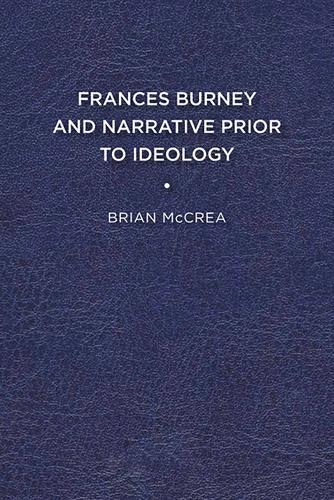
Frances Burney and Narrative Prior to Ideology works between Burney's Journals and Letters and her fiction more thoroughly than any study of her in the past twenty-five years. By doing so, it offers significant reinterpretations of Burney's four novels: Evelina, Cecilia, Camilla, and The Wanderer. It describes Burney's eluding the major modern–isms through which critics have tried to read her: Feminism (with its ""gendering"" of beauty and reversal of gender roles); Capitalism and its Marxist critique (here the details of Burney's housekeeping become important); Professionalism (as a response to status inconsistency and class conflict); and Ian Watt's ""Formal Realism"" (Burney perhaps saved the novel from a sharp decline it suffered in the 1770s, even as she tried to distance herself from the genre). Burney's most successful writing appeared before the coining of ""ideology."" But her standing ""prior to ideology"" is not a matter of chronological accident. Rather, she quietly but forcefully resisted shared explanations—domesticity as model for household management, debt as basis for family finance, professional status as a means to social confidence, the novel as the dominant literary genre—that became popular during her long and eventful life. Frederic Jameson has described Paul de Man, ""in private conversation,"" claiming, ""Marxism . . . has no way of understanding the eighteenth century."" Frances Burney and Narrative Prior to Ideology conjoins Burney's ""eighteenth-centuryness"" with her modernity. Published by University of Delaware Press. Distributed worldwide by Rutgers University Press.
Full Product Details
Author: Brian McCrea
Publisher: University of Delaware Press
Imprint: University of Delaware Press
Dimensions:
Width: 15.20cm
, Height: 1.20cm
, Length: 22.90cm
Weight: 0.313kg
ISBN: 9781644530702
ISBN 10: 1644530708
Pages: 234
Publication Date: 26 September 2013
Recommended Age: From 16 to 99 years
Audience:
College/higher education
,
College/higher education
,
Professional and scholarly
,
Tertiary & Higher Education
,
Tertiary & Higher Education
Format: Paperback
Publisher's Status: Active
Availability: In Print

This item will be ordered in for you from one of our suppliers. Upon receipt, we will promptly dispatch it out to you. For in store availability, please contact us.
Reviews
This quirky, personal, deeply satisfying book seeks to rescue Burney from the fashionable critical '-isms' that have recently clouded, rather than elucidated, her accomplishment. Though McCrea says he drew inspiration from Frederick Crew's Postmodern Pooh (2001), McCrea's volume is far more historically nuanced than such a comparison suggests. McCrea observes that Burney's novels were written outside the modern critical straitjacket through which scholars have interpreted her. Perhaps the best chapter is 'No Jacobins Here: Burney's Perplexing (Non)Politics.' Contemporary critics, e.g., Margaret Doody (who argued that 'the personal is political'), have presumed that Burney's novels reinforce a politics that aligns with their tastes, namely, the Jacobinism of those who hoped that French Revolutionary ideals would spread to England. Using Burney's nonfictional writings, McCrea convincingly argues that Burney's politics were exactly the opposite. He observes that to Burney, 'the personal is the personal' and that this resistance to ideology helps explain the failure of Burney's last novel, The Wanderer. McCrea is equally good on the way Burney does not fit into an Ian-Watt-like picture of 'the rise of the novel.' Criticism written against the grain has rarely been so accessible or so much fun. Summing Up: Highly recommended. Upper-division undergraduates through faculty.--CHOICE
Author Information
Brian McCrea is Professor Emeritus of English at the University of Florida, Gainesville, Florida and Visiting Lecturer in English at Flagler College, St. Augustine, Florida.