Overview
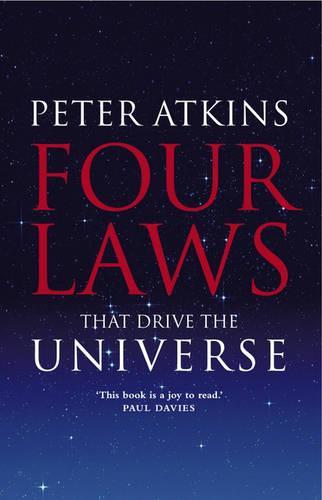
The laws of thermodynamics drive everything that happens in the universe. From the sudden expansion of a cloud of gas to the cooling of hot metal, and from the unfurling of a leaf to the course of life itself - everything is directed and constrained by four simple laws. They establish fundamental concepts such as temperature and heat, and reveal the arrow of time and even the nature of energy itself. Peter Atkins' powerful and compelling introduction explains what the laws are and how they work, using accessible language and virtually no mathematics. Guiding the reader from the Zeroth Law to the Third Law, he introduces the fascinating concept of entropy, and how it not only explains why your desk tends to get messier, but also how its unstoppable rise constitutes the engine of the universe.
Full Product Details
Author: Peter Atkins (Professor of Chemistry, University of Oxford and fellow of Lincoln College)
Publisher: Oxford University Press
Imprint: Oxford University Press
Dimensions:
Width: 13.80cm
, Height: 1.70cm
, Length: 20.40cm
Weight: 0.252kg
ISBN: 9780199232369
ISBN 10: 0199232369
Pages: 144
Publication Date: 06 September 2007
Audience:
College/higher education
,
Undergraduate
,
Postgraduate, Research & Scholarly
Format: Hardback
Publisher's Status: Active
Availability: To order

Stock availability from the supplier is unknown. We will order it for you and ship this item to you once it is received by us.
Reviews
His engaging account...the lucid figures offer readers a firm understanding of energy and entropy. Science Concise, well-written, engaging and carefully structured... an enjoyable and informative read. Chemistry World Peter Atkins's account of the core concepts of thermodynamics is beautifully crafted. Simon Mitton, THES A brief and invigoratingly limpid guide to the laws of thermodynamics. Saturday Guardian Atkins's systematic foundations should go a long way towards easing confusion about the subject...an engaging book, just the right length (and depth) for an absorbing, informative read. Mark Haw, Nature [Atkins'] ultra-compact guide to thermodynamics [is] a wonderful book that I wish I had read at university. New Scientist
His engaging account...the lucid figures offer readers a firm understanding of energy and entropy. Science Concise, well-written, engaging and carefully structured... an enjoyable and informative read. Chemistry World Peter Atkins's account of the core concepts of thermodynamics is beautifully crafted. Simon Mitton, THES A brief and invigoratingly limpid guide to the laws of thermodynamics. Saturday Guardian Atkins's systematic foundations should go a long way towards easing confusion about the subject...an engaging book, just the right length (and depth) for an absorbing, informative read. Mark Haw, Nature [Atkins'] ultra-compact guide to thermodynamics [is] a wonderful book that I wish I had read at university. New Scientist
`It takes not only a great writer but a great scientist with a lifetime's experience to explains uch a notoriously tricky area with absolute economy and precision, not to mention humour.' Books of the Year, Observer.
Author Information
Peter Atkins is the author of about 70 books, including the world-renowned and widely used Physical Chemistry, now in its 10th edition. He won the Grady-Stack award for science journalism in 2016. After graduating from the University of Leicester and a post-doctoral year in the University of California, Los Angeles, he returned to Oxford in 1965 as Fellow of Lincoln College and University Lecturer (later Professor) in physical chemistry. He retired in 2007, but continues to write and lecture worldwide.