Overview
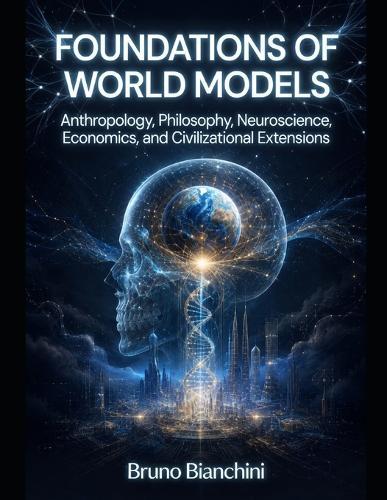
We are not living in the age of language AI but in the age of world models-systems that learn to predict, simulate, and plan by building internal representations of reality. Mistaking fluent language for genuine intelligence is the central illusion of our time. Part I dismantles this illusion. The human brain is wired to detect minds behind language, a survival mechanism that AI now exploits. Large language models are not thinking; they are statistically predicting the next word. The failure of symbolic AI and the ""symbol grounding problem"" show that intelligence requires more than rules and symbols-it requires embodiment and a connection to the world. Part II explores how biological minds model reality. The brain is a prediction engine, constantly generating models of the world and updating them via prediction error (the free energy principle). This predictive processing framework explains perception, action, and even hallucinations. True understanding requires embodiment-a body to ground meaning-and causal reasoning, not just pattern recognition. A world model must distinguish correlation from causation to intervene, plan, and survive. Part III explains how machines are building reality. Modern AI architectures (like Dreamer) combine perception, latent spaces, and dynamics modules to imagine possible futures. Machines can now traverse ""geometries of intelligence"" to generate novel outputs. However, they still lack persistent memory, robust agency, and the integrated information that may be necessary for genuine experience. The hard problem of consciousness remains unsolved, but as AI becomes more sophisticated, our moral obligations toward it may grow. Part IV confronts the economic revolution. When intelligence, the ultimate scarce resource, becomes a cheap commodity, the end of labor as we know it is inevitable. This is not just job loss-it is the severing of identity, purpose, and the social contract tied to work. The result could be post-scarcity abundance (liberation) or a new feudalism (where a few owners of AI infrastructure control all cognitive output). The key questions are: Who owns the data, the compute, and the models? Without radical institutional change, inequality will become structurally permanent. Part V maps the geopolitics of cognition. We are already in an AI Cold War between the US and China, fought over semiconductors, talent, data, and standards. This rivalry is creating a new form of intelligence colonialism, where the Global South provides raw data to the center in exchange for finished AI services, reinforcing dependency. The struggle for sovereign AI-a nation's capacity to control its own cognitive infrastructure-is now a core security issue, but true independence is hindered by the immense concentration of chips (TSMC), compute (cloud giants), and undersea cables. Part VI turns to the human question. If machines can know everything, what is education for? It must shift from knowledge transmission to developing capability, wisdom, and care. The sacred is not threatened by AI; it is clarified as the space of irreducibility-the territory that no model can capture, including finitude, suffering, and meaning. In a world of automation, meaning is not found in productivity but in community, craft, care, and contemplation. We are the species that builds minds. Our final task is not to compete with machines but to learn to live alongside them, bringing our mortal, wondering perspective to a universe we now predict together. Conclusion: The convergence of biological and artificial world models is the defining event of our century. It forces humanity to mature-to develop wisdom as fast as we develop power The future is not predetermined; it depends on the choices we make about ownership, governance, and what we consider sacred.
Full Product Details
Author: Bruno Bianchini
Publisher: Independently Published
Imprint: Independently Published
Dimensions:
Width: 21.60cm
, Height: 1.30cm
, Length: 27.90cm
Weight: 0.594kg
ISBN: 9798197650023
Pages: 254
Publication Date: 19 May 2026
Audience:
General/trade
,
General
Format: Paperback
Publisher's Status: Active
Availability: Available To Order

We have confirmation that this item is in stock with the supplier. It will be ordered in for you and dispatched immediately.