|
|
|||
|
||||
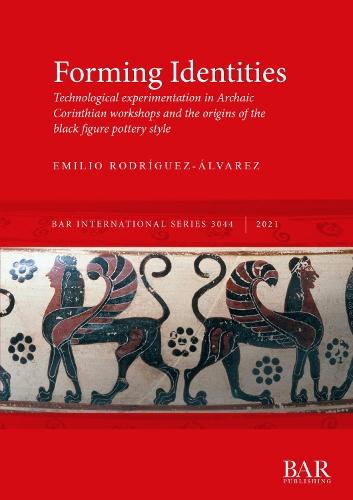
OverviewThis book focuses on the manufacturing techniques of Corinthian potters during the Archaic Period, as well as the relationships established with their natural environment. The results of this research show that the advent of the Black Figure pottery style was intrinsically related to the adoption by Corinthian potters of new manufacturing techniques and recipes for their paints and slips. This change of the paint and gloss recipes required the use of new raw materials, which takes the discussion on pottery production at the site from purely technical issues to social and economic ones, such as access and control of these scarce resources or the relationships between potters and their local community. The significance of this discovery also sheds new light upon the diversity of local styles in Greece. Full Product DetailsAuthor: Emilio Rodríguez-ÁlvarezPublisher: BAR Publishing Imprint: BAR Publishing Weight: 0.594kg ISBN: 9781407358185ISBN 10: 1407358189 Pages: 149 Publication Date: 31 August 2021 Audience: Professional and scholarly , Professional & Vocational Format: Paperback Publisher's Status: Active Availability: Available To Order We have confirmation that this item is in stock with the supplier. It will be ordered in for you and dispatched immediately. Table of ContentsList of figures List of tables Abstract Foreword Old Pots, New Ideas: An Introduction 1. The Polis of Corinth During the Archaic Period 1.1 Introduction 1.2 Prehistoric Corinth until the end of the Early Iron Age (c.6500 to 9th c. BCE) 1.3 The Bacchiadai Oligarchy (747 BCE-657 BCE) 1.4 The Tyranny of the Kypselidai (657-581 BCE) 1.5 The End of the Tyranny and the Second Oligarchy (581 BCE- 480 BCE) 1.6 Epilogue 2. Archaic Corinthian Pottery, Research History and Typology 2.1 Introduction 2.2 History of Corinthian Pottery Studies 2.3 Technological Studies on Greek and Corinthian Pottery 2.4 Visual and Literary Sources on Ancient Greek Pottery Production 2.5 Corinthian Ceramics in the Archaic Period: A Brief Typology 2.5.1 The Early Protocorinthian Period (720-690 BCE) 2.5.2 The Middle Protocorinthian Period (690-650 BCE) 2.5.3 The Late Protocorinthian Period (650-630 BCE) and the Transitional Period (630-620/615 BCE) 2.5.4 The Early Corinthian Period (620/615-595/592 BCE) 2.5.5 The Middle Corinthian Period (595/590-570 BCE) 2.5.6 The Late Corinthian Period (570-500 BCE) 3. Theoretical Perspectives on Pottery Studies 3.1 Introduction 3.2 Models of Inference in Archaeology: Behavioral Archaeology 3.3 Technology and Communities of Practice 3.3.1 Technological Studies in Behavioral Archaeology 3.3.2 Social Constructivism and Communities of Practice 3.4 Models of Interpretation 3.5 Archaeological Theory and Archaic Corinthian Pottery 4. Research Methodology 4.1 The Potters' Quarter: Site Excavation and Sampling Strategy 4.2 Database Design and Statistical Applications 4.3 Survey and Sampling of Raw Materials 4.4 Physical Properties Tests 4.5 X-ray Fluorescence Analysis 4.6 Summary 5. Research Results 5.1 Chronological Sequence of the Potters' Quarter 5.2 Standardization Analyses of Finds from the Potters' Quarter 5.3 Analyses of Raw Materials 5.3.1 General Characteristics of the Samples 5.3.2 Drying and Firing Shrinkage 5.3.3 Porosity Tests 5.4 pXRF Analysis of Fabrics, Source Clays and Decoration 5.4.1 Methodology and its Limitations in the Study 5.4.2 Multivariate Statistics on Fabrics, Paints and Glosses 5.4.3 Performance of the Raw Materials 5.4.4 Summary and Interpretation 5.5 The Behavioral Chain and the Manufacture of Pottery at Corinth 5.5.1 Acquisition of Raw Materials 5.5.2 Preparation of Raw Materials: 5.5.3 Forming the Vessel 5.5.4 Surface Treatments 5.5.5 Firing 5.5.6 Post-firing Treatments 5.6 Summary of the Results 6. Potters and Society 6.1 The Origins of the Black Figure Technique 6.2 The Origins of the Potters' Quarter 6.3 Workshop Organization and Apprenticeship 6.4 Economic Cost and Consumption of Pottery in Corinthian Society 6.5 The Resilience of the Corinthian Workshops Appendix 1. Profile Drawings of the Main Greek Pottery Shapes Appendix 2. Nomenclature of Greek pottery shapes (based on textual evidence) Appendix 3. Plan of the Potters' Quarter Appendix 4. Nomenclature and variables recorded for the description of vessels Appendix 5. Linear Shrinkage of Tested Briquettes (mm). Initial size 100 mm Appendix 6. Porosity Tests of Briquettes ReferencesReviews'The contribution is revolutionary, not just for Corinthian material but for all regional ceramics in Greece and probably farther afield.' Professor Amy C. Smith, Reading University 'This is a welcome and innovative approach on one of the best known and much discussed ancient Greek pottery categories that had a considerable influence on the development and dissemination of new techniques (black-figure), vase-shapes and decoration systems.' Professor Eleni Manakidou, Aristotle University of Thessaloniki Author InformationEmilio Rodríguez-Álvarez (SoA, University of Arizona) is a Galician archaeologist specialized in the study of communities of practice and ceramic technology. His research focuses on the application of material sciences, GIS, anthropology, and experimental archaeology to the reassessment of traditional models of interpretation of ancient Greek ceramics and manufacturers. Tab Content 6Author Website:Countries AvailableAll regions |
||||