Overview
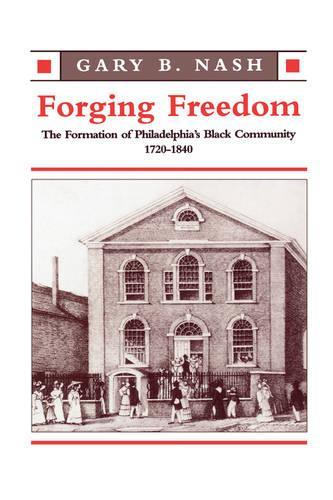
This book is the first to trace the good and bad fortunes, over more than a century, of the earliest large free black community in the United States. Gary Nash shows how, from colonial times through the Revolution and into the turbulent 1830s, blacks in the City of Brotherly Love struggled to shape a family life, gain occupational competence, organize churches, establish neighborhoods and social networks, advance cultural institutions, educate their children in schools, forge a political consciousness, and train black leaders who would help abolish slavery. These early generations of urban blacks-many of them newly emancipated-constructed a rich and varied community life. Nash's account includes elements of both poignant triumph and profound tragedy. Keeping in focus both the internal life of the black community and race relations in Philadelphia generally, he portrays first the remarkable vibrancy of black institution-building, ordinary life, and relatively amicable race relations, and then rising racial antagonism. The promise of a racially harmonious society that took form in the postrevolutionary era, involving the integration into the white republic of African people brutalized under slavery, was ultimately unfulfilled. Such hopes collapsed amid racial conflict and intensifying racial discrimination by the 1820s. This failure of the great and much-watched ""Philadelphia experiment"" prefigured the course of race relations in America in our own century, an enduringly tragic part of this country's past.
Full Product Details
Author: Gary B. Nash
Publisher: Harvard University Press
Imprint: Harvard University Press
Dimensions:
Width: 15.60cm
, Height: 1.90cm
, Length: 23.50cm
Weight: 0.585kg
ISBN: 9780674309333
ISBN 10: 0674309332
Pages: 372
Publication Date: 01 March 1991
Audience:
College/higher education
,
Professional and scholarly
,
Undergraduate
,
Postgraduate, Research & Scholarly
Format: Paperback
Publisher's Status: Active
Availability: Out of stock

The supplier is temporarily out of stock of this item. It will be ordered for you on backorder and shipped when it becomes available.
Reviews
Now comes this superbly written book by Gary Nash, one of the prolific scholars on the subject, on the early history of the races at a particularly crucial juncture that occurred in the city of Philadelphia that sheds insight into the entire process...A particular strength of his work lies in his detailing of the resiliency and creativity of black culture in the city. -- Joseph Boskin Los Angeles Times Book Review
Now comes this superbly written book by Gary Nash, one of the prolific scholars on the subject, on the early history of the races at a particularly crucial juncture that occurred in the city of Philadelphia that sheds insight into the entire process… A particular strength of his work lies in his detailing of the resiliency and creativity of black culture in the city. -- Joseph Boskin * Los Angeles Times Book Review * Nash’s book is a major contribution to our understanding of black life in the early American republic; it is a vivid and compelling account of the evolution of Philadelphia’s black community in a period of increasing racism. -- Eric Foner * American Historical Review * A compelling view of the development of black urban culture and society in Philadelphia. Masterfully researched and skillfully combining social scientific data and traditional documents, this work succeeds admirably as narrative and analysis. It easily ranks among the best work in the fields of black urban history and early American race relations. -- Waldo E. Martin, Jr. * William & Mary Quarterly * Gary Nash’s Forging Freedom is the most important book on the black experience in an American city yet written… No book better reveals how the early black experience in America became so persistently urban and naggingly ambivalent. No book better reveals how politics, social conditions, and religiosity in a colonial Quaker metropolis shaped modern Afro-American culture. And no book better demonstrates how hard-won, carefully sculpted, historical research, sophisticated interpretation, and clear, unambiguous prose remain the historian’s finest achievement. Forging Freedom is a triumph, most obviously for Nash, but most beneficially for any student of America who wants to know how and why our deepest, most enduring paradoxes found their origins so early and so tragically in urban racial tension. -- Jon Butler, Yale University A distinguished historian has given us a gift of major proportion. Nash presents a fascinating and unknown picture in remarkable detail. This moving and well-documented case study stretches all the way from Philadelphia’s early Quaker years to the agitation and conflict of the antebellum era. Students of later civil rights movements will be amazed by how far back the story goes, how familiar it sounds in certain parts, and how much of it can be recovered by a patient and determined scholar. -- Peter H. Wood, Duke University Nash is our preeminent historian of the early seaboard cities and a leading scholar of the black experience and race relations in early America. His research is energetic, absolutely current, very nearly exhaustive, and it yields an account that is vibrantly rendered. Much of the best material is on the blacks, much of the most horrifying on the whites, but always he maintains a difficult balance, capturing episodes and events as well as deeper trends on both sides of the racial divide in a narrative at once teeming and telling. -- Michael Zuckerman, University of Pennsylvania
A fascinating and moving study that explores the successes and failures of an early movement for black equality, laying bare the deep roots in America's history both of racial hatred and of egalitarian idealism. Nash (History/UCLA; The Urban Crucible: The Northern Seaports and the Origins of the American Revolution, 1979) traces Philadelphia's black community from the days of stavery in the mid-18th century to the heyday of abolitionism and interracial harmony in the post-revolutionary period to the increasingly tense situation faced by independent and successful blacks in the financially depressed 1820's and 1830's. The idealistic belief in natural rights and the conviction that the condition of the blacks was due not to race but to the depravity of slavery (the environmentalist theory) gave way to the view among whites - often backed up by such pseudoscientific methodologies as phrenology - that blacks were by nature inferior to whites. An ideal of racial integration and desire for black achievement disintegrated into race riots in the street and mockery in cartoons and tabloids of the pretentions of the growing black middle class. Nash shows that despite increasing segregation and violence, the black community was well-established, successful, and strong by the 1820's. But it would be another 100 years before the lost ideals of the 1780's and 1790's were recovered. A few leaders - Benjamin Rush, the abolitionist; James Forten, the sailmaker and political leader; Richard Allen, the Methodist minister - emerge from these pages as extraordinary individuals who influenced the course of history. But this is mostly a study of the average man and woman, of coachmen and maids and oystermen, the quality of whose lives Nash reconstructs with extraordinary vividness from public records, census data, and old newspapers. (Kirkus Reviews)
Author Information
Gary B. Nash is Professor of History Emeritus, University of California, Los Angeles, and Professor and Director, National Center for History in the Schools.