Overview
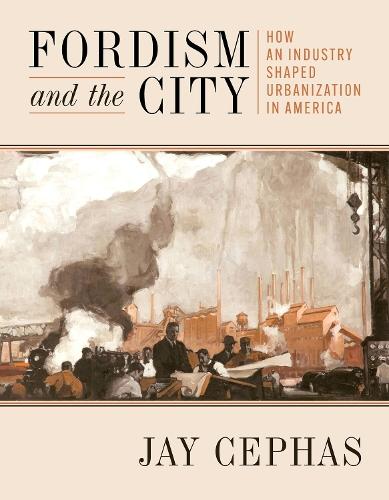
In the early twentieth century, the Ford Motor Company built an industrial empire with massive factory complexes and associated infrastructures. Henry Ford’s 1915 plan to decentralize industrial manufacturing relied on moving key technical processes closer to sites of resource extraction while distributing elements of production. In Fordism and the City, Jay Cephas analyzes key infrastructures—from factories and mills to roads, rail lines, and canals—to trace the impact of automated, assembly-line production on the urban and rural landscapes of Michigan. The overwhelming scale of the Ford Motor Company’s plant in Dearborn, the idyllic setting of its small village factories throughout the Rouge River corridor, and the remoteness of the company’s iron ore mines and hardwood forests in the Upper Peninsula all played an important role. Under the rubric of “the industrial city,” Fordism sought to replace conventional urbanism, reconfiguring factory production and then making its practices visible and intelligible to a consuming public through an industrial aesthetic. In doing so, Cephas shows, Fordism functioned as a normalizing force that helped to usher in the new industrial society.
Full Product Details
Author: Jay Cephas
Publisher: University of Pittsburgh Press
Imprint: University of Pittsburgh Press
ISBN: 9780822948810
ISBN 10: 0822948818
Pages: 300
Publication Date: 17 March 2026
Audience:
Professional and scholarly
,
College/higher education
,
Professional & Vocational
,
Postgraduate, Research & Scholarly
Format: Hardback
Publisher's Status: Forthcoming
Availability: Not yet available

This item is yet to be released. You can pre-order this item and we will dispatch it to you upon its release.
Reviews
In this fascinating study, architectural historian Jay Cephas shows that Fordism was never confined to the assembly line, the factory complex, or the industrial city. It was, rather, a territorial formation that linked the machinery of production to landscapes of extraction and circulation through a vast industrial metabolism that included mines, forests, fields, waterways, highways, railroads, urban networks, and metropolitan centers. Fordism and the City is an essential scholarly resource for anyone interested in the interplay between labor, urbanism, technology, territory, and environment.--Neil Brenner, University of Chicago
In this fascinating study, architectural historian Jay Cephas shows that Fordism was never confined to the assembly line, the factory complex, or the industrial city. It was, rather, a territorial formation that linked the machinery of production to landscapes of extraction and circulation through a vast industrial metabolism that included mines, forests, fields, waterways, highways, railroads, urban networks, and metropolitan centers. Fordism and the City is an essential scholarly resource for anyone interested in the interplay between labor, urbanism, technology, territory, and environment. -- Neil Brenner, University of Chicago
Author Information
Jay Cephas is a historian who studies the impact of labor, technology, and social identity on the built environment. He is assistant professor in the history and theory of architecture at Princeton University, where he is also a research director of the Princeton-Mellon Initiative in Architecture, Urbanism, and the Humanities. Cephas is also the founding director of the Black Architects Archive, an interactive repository that documents the physical, intellectual, and creative labor deployed by the Black architects, builders, landscape architects, and contractors who helped shape the American built environment across the nineteenth and twentieth centuries. Cephas was recently named a Conserving Black Modernism Fellow at the African American Cultural Heritage Action Fund of the National Trust for Historic Preservation. Cephas is a member of the African American Intellectual History Society, Urban History Association, Society for American City and Regional Planning History, Labor and Working Class History Association, Society for the History of Technology, and Society of Architectural Historians.