Overview
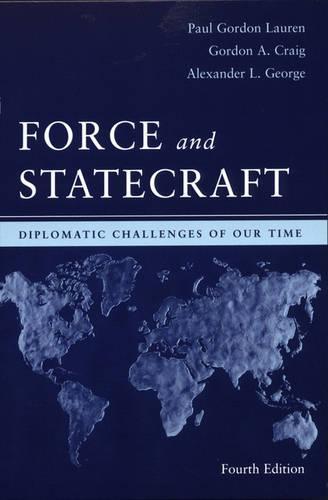
Force and Statecraft is a concise historical account and insightful analysis of diplomacy. It combines history, political science, and international law in a unique interdisciplinary approach to explore how lessons from the rich experience of the past can be brought to bear on the diplomatic challenges that confront our world today. Now thoroughly revised, updated, and enhanced, the book combines the cumulative insights and reflections of three distinguished scholars with international reputations who have written more than fifty books between them. Paul Gordon Lauren has been involved with the book from the beginning and brings a fresh perspective to this edition. In lucid prose and clear organization, the fourth edition surveys the evolution of the international system from the emergence of diplomacy and the rise of the modern state in the seventeenth century to the present. It then takes the reader into an analysis of some of the most important issues of statecraft. Now much more international and global in scope, this edition contains a number of new case studies, including the negotiations over nuclear weapons in North Korea, and a discussion of recent events. It also offers completely new or significantly expanded coverage of such topics as the impact of terrorism and 9/11, international human rights, ethics, the ""lessons"" of history, globalization, the United Nations, the growing role of nonstate actors, weapons of mass destruction, just war theory, and the legitimate use of armed force. For the first time, this edition contains illustrations, maps, and website references to guide readers. Force and Statecraft is both a classic and a timely resource ideal for those interested in diplomatic history, international relations, foreign affairs, statecraft, and security studies.
Full Product Details
Author: Paul Gordon Lauren (Regents Professor of History, University of Montana) ,
Gordon A. Craig (J.E. Wallace Sterling Professor of Humanities, Stanford University (Emeritus)) ,
Alexander L. George (Graham H. Stuart Professor of International Relations, Stanford University)
Publisher: Oxford University Press
Imprint: Oxford University Press
Edition: 4th Revised edition
Dimensions:
Width: 15.60cm
, Height: 2.20cm
, Length: 23.50cm
Weight: 0.464kg
ISBN: 9780195162493
ISBN 10: 0195162498
Pages: 316
Publication Date: 28 September 2006
Audience:
Professional and scholarly
,
Professional & Vocational
Format: Paperback
Publisher's Status: Out of Print
Availability: In Print

Limited stock is available. It will be ordered for you and shipped pending supplier's limited stock.
Reviews
<br> Force and Statecraft is . . . a great classic on the topic. --Jalil Roshandel, Duke University<p><br> This is the best book in terms of its organization, writing, and quality of ideas as well as a superb framing of the problems and issues in this field. --John D. Stempel, University of Kentucky<p><br>
Force and Statecraft is . . . a great classic on the topic. --Jalil Roshandel, Duke University<br> This is the best book in terms of its organization, writing, and quality of ideas as well as a superb framing of the problems and issues in this field. --John D. Stempel, University of Kentucky<br>