Overview
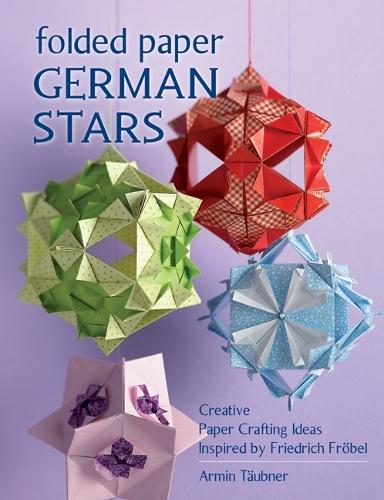
Paper folding crafts are fun for all ages! You'll be amazed at what you can create with pretty paper and a few strategic folds. Colorful Froebel stars can be used as ornaments, table decorations, candle holders, and more, and a variety of other shapes make festive gift toppers, toys, mobiles, and garlands.
Full Product Details
Author: Armin Taubner ,
Armin Teaubner
Publisher: Stackpole Books
Imprint: Stackpole Books
Dimensions:
Width: 21.60cm
, Height: 1.00cm
, Length: 28.00cm
Weight: 0.374kg
ISBN: 9780811714563
ISBN 10: 081171456
Pages: 96
Publication Date: 29 April 2015
Audience:
General/trade
,
General
Format: Paperback
Publisher's Status: Active
Availability: Available To Order

We have confirmation that this item is in stock with the supplier. It will be ordered in for you and dispatched immediately.
Reviews
July 2015 Fröbel star rating: *** I zoomed in on this title because it celebrates the work of Friedrich Fröbel. Fröbel was a 19th century German educationalist and papercraft guru. He brainstormed the concept of kindergarten. He - wait-for it - re-introduced the craft of origami to Japanese schoolchildren. And his papercraft legacy lives on in the celestial contribution of his famous 3-D woven stars – a trad Christmas decoration – and in his folded paper shapes. (The big idea is that paper folding teaches creativity, logical thinking, and improves motor co-ordination.) Back to the review. This is a reprint of German edition. Armin Täubner is a prolific papercraft author, whose delightful Floragami, I have reviewed on this blog. The book begins with a collection of folded modular shapes - kind of the origami equivalent of paper snowflakes. Slight permutations, no two alike. Lots of geek appeal. The “moves” are indicated with step-by-step folding diagrams + text. A winning idea is to fold the shapes in translucent paper to make window decorations. After the basic folded shapes are shown, the author moves on to 3-D constructions. This section is not for origami purists because – shock horror – glue is involved. The resulting spheres are very attractive – and are “cheats” kusudama. The gluing enables an openwork appearance, which is extremely appealing. As you would expect, the Fröbel star section kick-starts with detailed, illustrated how-tos on how to weave the eponymous stars out of strips of paper. The steps are pretty clear – but, if you are like me – you may zone out when things get to about step 28 (and I like learning from books). My suggestion: check out a You Tube video and use it in conjunction with the book. And always bear in mind that the paper weaving steps are repetitive – so there are fewer folding operations than the number of steps. Super-symmetry. Everything is done in quad! When you master the star, you will be very proud of yourself, and you will have added a life-long papercraft skill – and party trick- to your repertoire. The Fröbel star projects are mostly slight permutations – but, hey - you would not be reading this book if you were not a papercraft geek. The comet is a fun idea. Most of the variations involve trimming the tails in some way, or varying the colours of the paper folding strips. A bit obvious. So – this title is a pleasant tribute to the papercraft innovations of Friedrich Fröbel. It is suitable for entry level to intermediate papercrafters. * The Papercraft Post Blog *
July 2015 Froebel star rating: *** I zoomed in on this title because it celebrates the work of Friedrich Froebel. Froebel was a 19th century German educationalist and papercraft guru. He brainstormed the concept of kindergarten. He - wait-for it - re-introduced the craft of origami to Japanese schoolchildren. And his papercraft legacy lives on in the celestial contribution of his famous 3-D woven stars - a trad Christmas decoration - and in his folded paper shapes. (The big idea is that paper folding teaches creativity, logical thinking, and improves motor co-ordination.) Back to the review. This is a reprint of German edition. Armin Taubner is a prolific papercraft author, whose delightful Floragami, I have reviewed on this blog. The book begins with a collection of folded modular shapes - kind of the origami equivalent of paper snowflakes. Slight permutations, no two alike. Lots of geek appeal. The moves are indicated with step-by-step folding diagrams + text. A winning idea is to fold the shapes in translucent paper to make window decorations. After the basic folded shapes are shown, the author moves on to 3-D constructions. This section is not for origami purists because - shock horror - glue is involved. The resulting spheres are very attractive - and are cheats kusudama. The gluing enables an openwork appearance, which is extremely appealing. As you would expect, the Froebel star section kick-starts with detailed, illustrated how-tos on how to weave the eponymous stars out of strips of paper. The steps are pretty clear - but, if you are like me - you may zone out when things get to about step 28 (and I like learning from books). My suggestion: check out a You Tube video and use it in conjunction with the book. And always bear in mind that the paper weaving steps are repetitive - so there are fewer folding operations than the number of steps. Super-symmetry. Everything is done in quad! When you master the star, you will be very proud of yourself, and you will have added a life-long papercraft skill - and party trick- to your repertoire. The Froebel star projects are mostly slight permutations - but, hey - you would not be reading this book if you were not a papercraft geek. The comet is a fun idea. Most of the variations involve trimming the tails in some way, or varying the colours of the paper folding strips. A bit obvious. So - this title is a pleasant tribute to the papercraft innovations of Friedrich Froebel. It is suitable for entry level to intermediate papercrafters. * The Papercraft Post Blog *
Author Information
Armin Taubner is the author of more than 25 books on origami and other paper crafts.