|
|
|||
|
||||
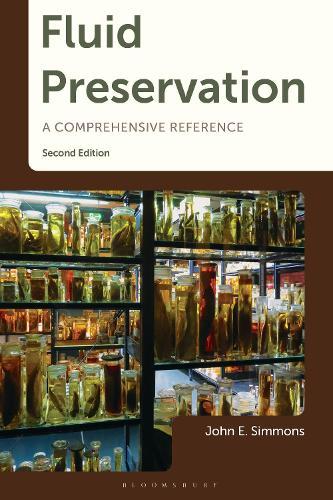
OverviewThis revised edition of Fluid Preservation: A Comprehensive Reference has been updated with a wealth of new research published during the last decade on preserving specimens in alcohol, formaldehyde, and other fluids. The text includes an expanded comprehensive bibliography and sections on managing fluid-preserved collections, determining preservative concentration, storage environments, preservation history and techniques, anatomical preparations, health and safety, fluid-preserved specimens in art and history museums, and cultural interpretations of fluid preservation in art, literature, and film. Although fluid preservation has been practiced for more than 350 years, Fluid Preservation: A Comprehensive Reference remains the only reference that thoroughly summarizes current knowledge about this complex and often confusing topic. Full Product DetailsAuthor: John E. SimmonsPublisher: Bloomsbury Publishing Plc Imprint: Bloomsbury Academic Edition: 2nd edition ISBN: 9798216366720Pages: 328 Publication Date: 22 January 2026 Audience: Professional and scholarly , Professional & Vocational Format: Hardback Publisher's Status: Forthcoming Availability: Manufactured on demand Table of ContentsTable of Contents List of Figures List of Boxes List of Tables Preface Acknowledgements Chapter 1. History of Fluid Preservation History of Ethyl Alcohol The Discovery of Preservation of Specimens in Ethyl Alcohol Instructions for Preserving Specimens in Fluids up to 1800 Instructions for Preserving Specimens in Fluids 1800 to 1900 The Introduction of Formaldehyde Botanical Fluid Preservation after about 1900 Instructions for Preserving Specimens in Fluids after 1900 Other Fluid Preservatives Summary Chapter 2. Fixation Formaldehyde Commercial Formaldehyde Formaldehyde as a Fixative and Preservative Factors that Affect Fixation Time and Penetration Rate and Depth Temperature Tissue Structure and Composition Buffering and Fixative pH Range Concentration Formaldehyde and the Preservation of DNA Botanical Fixatives Narcotization Fixatives for Botanical Specimens Lipids and Fixation Formaldehyde and Field Work Post-Formaldehyde Fixation Washing Unwanted Effects of Formaldehyde Gluteraldehyde Aldehyde Safety Alternative and Proprietary Fixatives Summary Chapter 3. Preservation Preservation without Fixation Transfer between Fluids Preservative Quality Botanical Uses of Fluid Preservation Glycerin Isopropyl Alcohol Fluid Preservation of DNA Evaporation Anatomical and Histological Fluid Preparations Mounting Specimens Inside Containers Glycol, Phenol, and Phenoxetol as Preservatives Mineral Oil Universal Fixatives Criteria for Evaluating Alternative Fixative and Preservative Fluids Chapter 4. Effects of Fixatives and Preservatives on Specimens Changes in Body Dimensions and Biomass Changes in Color Solvent Extraction by Fixatives and Preservatives Chapter 5. Managing Fluid-preserved Collections Standard Operating Procedures Monitoring Containers, Specimens, and Fluid Preservatives Monitoring the Storage Environment Integrated Pest Management Curators, Collection Managers, and Others Fluid-Preserved Collection Facilities Identification of Fluid Preservatives Determining Fluid Concentration pH of Preservative Solutions Preparing Fixatives and Preservatives Containers and Seals Labeling The Storage Environment Use of Specimens Topping Up and Replacing Preservatives Why do Closures Fail? Microbial Growth in Fluid Collections—Detection and Remediation Rehabilitation of Fluid-Preserved Collections Rehydration of Fluid-Preserved Specimens Moving Fluid-Preserved Collections Exhibition of Fluid-Preserved Specimens Old Containers and Old Specimens Repair of Damaged Fluid-Preserved Specimens Health and Safety Alcohol Safety Formaldehyde Safety Fire Prevention and Detection Disaster Preparedness Plans for Fluid-Preserved Collections Summary Chapter 6. Fluid-preserved Collections as Cultural Patrimony Why Preserve Specimens in Fluid? The Fluid-preserved Human Fond Memories of Fluid Preservation Fluid Preservation in Visual Art Fluid Preservation in Literature Fluid Preservation in Film Fluid Preservation in Popular Culture The Aesthetics and Importance of Fluid Preservation Literature Cited Reference Tables Appendix: Other Fluid Preservation LiteratureIndex About the AuthorReviewsAuthor InformationJohn E. Simmons (B.S., Systematics and Ecology; M.A., Museum Studies) worked as a zoo keeper before becoming a collection manager at the California Academy of Sciences and later at the Natural History Museum at the University of Kansas, where he also served as Director of the Museum Studies Program until 2007. He has published more than 150 papers and books on museology and the care of collections, particularly for natural history. Since 2008, Simmons has run Museologica, an international museum consulting service, and has taught workshops and university classes on the care of collections in the U.S. and abroad. Tab Content 6Author Website:Countries AvailableAll regions |
||||