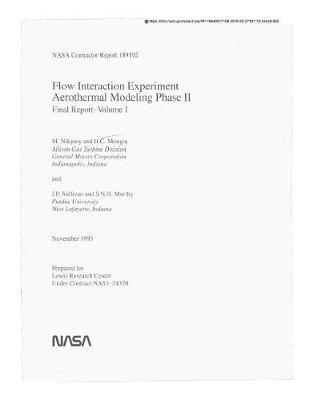
Flow Interaction Experiment. Volume 1: Aerothermal Modeling, Phase 2

Author:   National Aeronaut Administration (Nasa)
Publisher:   Createspace Independent Publishing Platform
ISBN:  

9781724217929


Pages:   380
Publication Date:   24 July 2018
Format:   Paperback
Availability:   Available To Order   Availability explained
We have confirmation that this item is in stock with the supplier. It will be ordered in for you and dispatched immediately.

Our Price $92.37 Quantity:  
Add to Cart

Share |

Flow Interaction Experiment. Volume 1: Aerothermal Modeling, Phase 2


Overview

An experimental and computational study is reported for the flow of a turbulent jet discharging into a rectangular enclosure. The experimental configurations consisting of primary jets only, annular jets only, and a combination of annular and primary jets are investigated to provide a better understanding of the flow field in an annular combustor. A laser Doppler velocimeter is used to measure mean velocity and Reynolds stress components. Major features of the flow field include recirculation, primary and annular jet interaction, and high turbulence. A significant result from this study is the effect the primary jets have on the flow field. The primary jets are seen to create statistically larger recirculation zones and higher turbulence levels. In addition, a technique called marker nephelometry is used to provide mean concentration values in the model combustor. Computations are performed using three levels of turbulence closures, namely k-epsilon model, algebraic second moment (ASM), and differential second moment (DSM) closure. Two different numerical schemes are applied. One is the lower-order power-law differencing scheme (PLDS) and the other is the higher-order flux-spline differencing scheme (FSDS). A comparison is made of the performance of these schemes. The numerical results are compared with experimental data. For the cases considered in this study, the FSDS is more accurate than the PLDS. For a prescribed accuracy, the flux-spline scheme requires a far fewer number of grid points. Thus, it has the potential for providing a numerical error-free solution, especially for three-dimensional flows, without requiring an excessively fine grid. Although qualitatively good comparison with data was obtained, the deficiencies regarding the modeled dissipation rate (epsilon) equation, pressure-strain correlation model, and the inlet epsilon profile and other critical closure issues need to be resolved before one can achieve the degree of accuracy required to analyti...

Full Product Details

Author:   National Aeronaut Administration (Nasa)
Publisher:   Createspace Independent Publishing Platform
Imprint:   Createspace Independent Publishing Platform
Dimensions:   Width: 21.60cm , Height: 2.00cm , Length: 27.90cm
Weight:   0.880kg
ISBN:  

9781724217929


ISBN 10:   1724217925
Pages:   380
Publication Date:   24 July 2018
Audience:   General/trade ,  General
Format:   Paperback
Publisher's Status:   Active
Availability:   Available To Order   Availability explained
We have confirmation that this item is in stock with the supplier. It will be ordered in for you and dispatched immediately.

Table of Contents

Reviews

Author Information

Tab Content 6

Author Website:  

Countries Available

All regions
Latest Reading Guide

April RG 26_2


Shopping Cart
Your cart is empty
Shopping cart
Mailing List