Awards
- Short-listed for Canada Prize in the Humanities and Social Sciences, Federation for the Humanities and Social Sciences 2020 (Canada)
- Winner of John T. Saywell Prize for Canadian Constitutional Legal History, The Osgoode Society for Canadian Legal History 2020 (Canada)
Overview
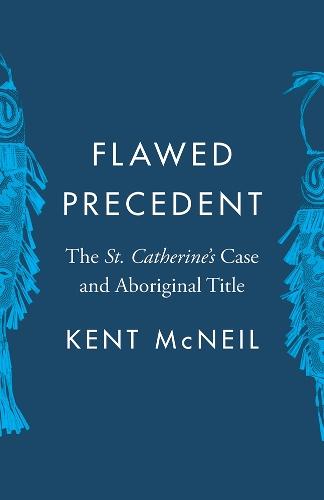
In 1888, the Judicial Committee of the Privy Council ruled in St. Catherine's Milling and Lumber Company v. The Queen, a case involving the Saulteaux people's land rights in Ontario. This precedent-setting case would define the legal contours of Aboriginal title in Canada for almost a hundred years, despite the racist assumptions about Indigenous peoples at the heart of the case. In Flawed Precedent, preeminent legal scholar Kent McNeil provides a compelling account of this contentious case. He begins by delving into the historical and ideological context of the 1880s. He then examines the trial in detail, demonstrating how prejudicial attitudes towards Indigenous peoples influenced the decision. He further discusses the effects that St. Catherine's had on law and policy until the 1970s when its authority was finally questioned in Calder, then in Delgamuukw, Marshall/Bernard, Tsilhqot'in, and other key rulings. He also provides an informative analysis of the current judicial understanding of Aboriginal title in Canada, now driven by evidence of Indigenous law and land use rather than by the discarded prejudicial assumptions of a bygone era.
Full Product Details
Author: Kent McNeil
Publisher: University of British Columbia Press
Imprint: University of British Columbia Press
Weight: 0.440kg
ISBN: 9780774861069
ISBN 10: 0774861061
Pages: 352
Publication Date: 01 June 2019
Audience:
Professional and scholarly
,
Professional & Vocational
Format: Paperback
Publisher's Status: Active
Availability: In Print

This item will be ordered in for you from one of our suppliers. Upon receipt, we will promptly dispatch it out to you. For in store availability, please contact us.
Author Information
Kent McNeil is an Emeritus Distinguished Research Professor at Osgoode Hall Law School, York University. He is a member of the Royal Society of Canada and was a recipient of a prestigious Killam Fellowship in 2007. He has published numerous works on the rights of Indigenous peoples, including two books: Common Law Aboriginal Title (1989) and Emerging Justice? Essays on Indigenous Rights in Canada and Australia (2001). He has also co-edited a collection, Indigenous Peoples and the Law: Comparative and Critical Perspectives (2009). His work has been relied on by the Supreme Court of Canada and the High Court of Australia in landmark decisions on Indigenous land rights. He has also provided advice to Indigenous peoples in Australia, Belize, Canada, and New Zealand.