Overview
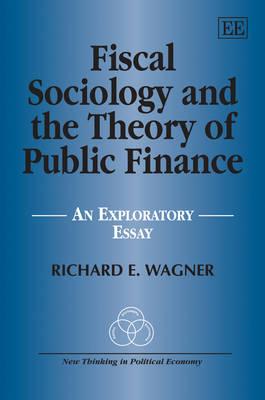
This book advances a social-theoretic treatment of public finance, which contrasts with the typical treatment of government as an agent of intervention into a market economy. To start, Richard Wagner construes government not as an agent but as a polycentric process of interaction, just as is a market economy. The theory of markets and the theory of public finance are thus construed as complementary components of a broader endeavor of social theorizing, with both seeking to provide insight into the emergence of generally coordinated relationships within society. The author places analytical focus on emergent processes of development rather than on states of equilibrium, and with much of that development set in motion by conflict among people and their plans. Some of the book's defining characteristics include: Budgets emerge through organizationally constituted political entrepreneurship Government is construed as a process of interaction and participation and not as a unitary entity of intervention Government and markets are incorporated into a unified theory of property which is traced to human nature and its requirements for both autonomy and solidarity. Richard Wagner's book will be of interest to researchers in public finance, public choice, Austrian economics, political science and public policy.
Full Product Details
Author: Richard E. Wagner
Publisher: Edward Elgar Publishing Ltd
Imprint: Edward Elgar Publishing Ltd
ISBN: 9781848444744
ISBN 10: 1848444745
Pages: 240
Publication Date: 31 March 2009
Audience:
College/higher education
,
Undergraduate
,
Postgraduate, Research & Scholarly
Format: Paperback
Publisher's Status: Active
Availability: Awaiting stock

The supplier is currently out of stock of this item. It will be ordered for you and placed on backorder. Once it does come back in stock, we will ship it out for you.
Reviews
'Wagner brings remarkable scholarship to bear on elucidating the emergent approach and connecting it to the vast and varied public finance literature.' -- Brian Pitt, Review of Austrian Economics 'Richard Wagner's process-oriented analysis of the public sector offers an insightful alternative to standard public finance theory and a powerful critique of neoclassical welfare economics. His ideas will prove valuable to any scholar interested in understanding the economic activities of government.' -- Randall G. Holcombe, Florida State University, US 'Written by one of the premier scholars of fiscal process in the world, this book takes an approach that mixes common sense and a radical redefinition of the nature of fiscal process. Rather than an incremental advance in assessing taxing and spending, Richard Wagner opens new vistas by examining the foundations of collective activity. He rejects the standard treatment of fiscal management as a corrective to market failure, and starts with the first principles of government action. I don't know when I have learned more from a single book.' -- Michael Munger, Duke University, US 'This is a highly original and creative argument by a major political economist to rethink how the public economy is studied. Instead of treating the public sector as a corrective agency for problems that may arise in the private economy, Professor Wagner proposes to study the public square in the same way that modern economists approach the private square . This involves eschewing equilibrium theories and emphasizing evolutionary competitive processes, examining property rights structures, stressing the role of entrepreneurship, and, in short, applying the principles of the New Institutional Economics to government. Wagner gives many convincing examples of how to apply his approach, all to good effect. This is an important book that deserves to be read widely and taken seriously. Learning the lessons that Wagner wants to teach us holds the promise of turning the study of public economics into a proper scientific explanation of government rather than an empty exercise in evaluation and intervention.' -- Robert D. Tollison, Clemson University, US
'Richard Wagner's process-oriented analysis of the public sector offers an insightful alternative to standard public finance theory and a powerful critique of neoclassical welfare economics. His ideas will prove valuable to any scholar interested in understanding the economic activities of government.'- Randall G. Holcombe, Florida State University, US'Written by one of the premier scholars of fiscal process in the world, this book takes an approach that mixes common sense and a radical redefinition of the nature of fiscal process. Rather than an incremental advance in assessing taxing and spending, Richard Wagner opens new vistas by examining the foundations of collective activity. He rejects the standard treatment of fiscal management as a corrective to market failure, and starts with the first principles of government action. I don't know when I have learned more from a single book.'- Michael Munger, Duke University, US'This is a highly original and creative argument by a major political economist to rethink how the public economy is studied. Instead of treating the public sector as a corrective agency for problems that may arise in the private economy, Professor Wagner proposes to study the A public squareA in the same way that modern economists approach the A private squareA . This involves eschewing equilibrium theories and emphasizing evolutionary competitive processes, examining property right structures, stressing the role of entrepreneurship, and, in short, applying the principles of the New Institutional Economics to government. Wagner gives many convincing examples of how to apply his approach, all to good effect. This is an important book that deserves to be read widely and taken seriously. Learning the lessons that Wagner wants to teach us holds the promise of turning the study of public economics into a proper scientific explanation of government rather than an empty exercise in evaluation and intervention.'- Robert D. Tollison, Clemson University, US
Author Information
Richard E. Wagner, Emeritus Professor of Economics, George Mason University, US