Overview
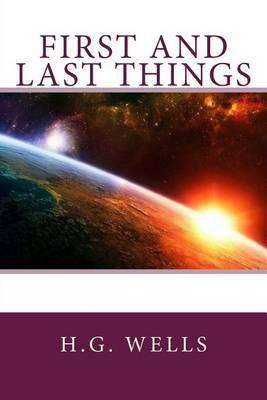
First and Last Things is a 1908 work of philosophy by H. G. Wells setting forth his beliefs in four books entitled Metaphysics, Of Belief, Of General Conduct, and Some Personal Things. Parts of the book were published in the Independent Magazine in July and August 1908.Wells revised the book extensively in 1917, in response to his religious conversion, but later published a further revision in 1929 that restored much of the book to its earlier form. Its main intellectual influences are Darwinism and certain German thinkers Wells had read, such as August Weismann. The pragmatism of William James, who had become a friend of Wells, was also an influence. In the first book, Wells emphasises his scepticism: neither the senses nor the mind can be relied upon uncritically, and The world of fact is not what it appears to be. Beliefs are not convictions, but rather positions arrived at exactly as an artist makes a picture and are adopted because I feel a need for them, because I feel an often quite unanalysable rightness in them. . . . My belief in them rests upon the fact that they work for me and satisfy a desire for harmony and beauty. In the second book, devoted to his essential beliefs, Wells asserts as quite an arbitrary act of my mind and a choice his most comprehensive belief : the external and the internal and myself . . . make one universe in which I and every part are ultimately important. On this point, he refuses argument, calling this unfounded and arbitrary declaration to be his fundamental religious confession. But he rejects use of the name of God because the run of people would misunderstand his meaning. He affirms the freedom of the will, and asserts that 'What am I to do?' is the perpetual question of our existence. After analysing the various motives to action that he feels, he resolves them by embracing a ruling idea, viz. an historically emerging solidarity of humanity, although he acknowledges that the species is still as a whole unawakened, still sunken in the delusion of the permanent separateness of the individual and of races and nations. Wells, however, regards this solidarity of humanity as a biological fact. The direction of this human development is to Power and Beauty, but he takes a confessedly mystical attitude in regard to these terms, refusing to define, or even to distinguish them. He rejects personal immortality. He criticises the Christianity he was raised in because he does not believe in the existence of a divine-human friend and mediator (though he admits the splendid imaginative appeal of the idea).He regards all religions to be in a measure true, but also as false.
Full Product Details
Author: H G Wells ,
Howard Rubin
Publisher: Createspace Independent Publishing Platform
Imprint: Createspace Independent Publishing Platform
Dimensions:
Width: 15.20cm
, Height: 0.50cm
, Length: 22.90cm
Weight: 0.132kg
ISBN: 9781519662903
ISBN 10: 1519662904
Pages: 90
Publication Date: 09 December 2015
Audience:
General/trade
,
General
Format: Paperback
Publisher's Status: Active
Availability: Available To Order

We have confirmation that this item is in stock with the supplier. It will be ordered in for you and dispatched immediately.