|
|
|||
|
||||
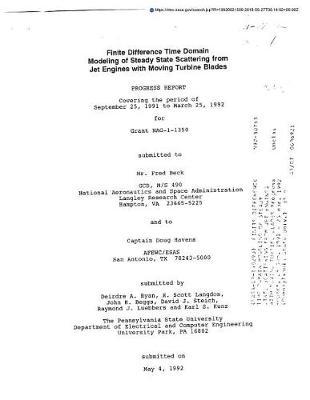
OverviewThe approach chosen to model steady state scattering from jet engines with moving turbine blades is based upon the Finite Difference Time Domain (FDTD) method. The FDTD method is a numerical electromagnetic program based upon the direct solution in the time domain of Maxwell's time dependent curl equations throughout a volume. One of the strengths of this method is the ability to model objects with complicated shape and/or material composition. General time domain functions may be used as source excitations. For example, a plane wave excitation may be specified as a pulse containing many frequencies and at any incidence angle to the scatterer. A best fit to the scatterer is accomplished using cubical cells in the standard cartesian implementation of the FDTD method. The material composition of the scatterer is determined by specifying its electrical properties at each cell on the scatterer. Thus, the FDTD method is a suitable choice for problems with complex geometries evaluated at multiple frequencies. It is assumed that the reader is familiar with the FDTD method. Ryan, Deirdre A. and Langdon, H. Scott and Beggs, John H. and Steich, David J. and Luebbers, Raymond J. and Kunz, Karl S. Unspecified Center NAG1-1350... Full Product DetailsAuthor: National Aeronaut Administration (Nasa)Publisher: Createspace Independent Publishing Platform Imprint: Createspace Independent Publishing Platform Dimensions: Width: 21.60cm , Height: 0.20cm , Length: 27.90cm Weight: 0.109kg ISBN: 9781722235956ISBN 10: 1722235950 Pages: 36 Publication Date: 03 July 2018 Audience: General/trade , General Format: Paperback Publisher's Status: Active Availability: Available To Order We have confirmation that this item is in stock with the supplier. It will be ordered in for you and dispatched immediately. Table of ContentsReviewsAuthor InformationTab Content 6Author Website:Countries AvailableAll regions |
||||