Overview
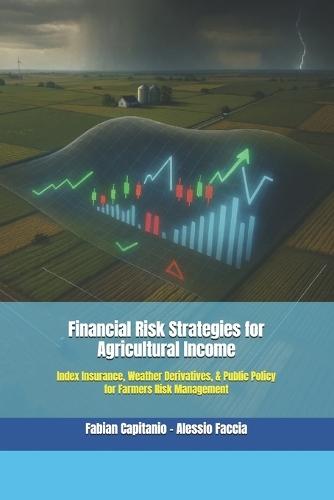
Farm income swings with weather, prices, and policy. This book treats that volatility head-on, separating what can be priced from what remains ambiguous, and testing every popular fix, insurance subsidies, index products, and derivative overlays, against evidence, maths, and field operations. The tone is deliberately sceptical: does subsidising premiums truly stabilise income, or does it conceal structural fragility? What happens when an index lags the crop calendar? Where do governance and data quality fail long before any model does? Part I builds the analytical spine. Expected utility, stochastic dominance, risk premia, and no-arbitrage are presented without hand-waving, then applied to forwards, options, weather derivatives, and the Black-Scholes framework. Readers see how volatility, tail shape, and dependence (copulas, EVT) alter VaR and CVaR for real farms, not textbook toys. Worked micro-cases show why ""price locked"" rarely means ""margin safe"", and how poor contract clauses, basis risk, or thin liquidity can erase gains even when the market view is right. Part II turns to agriculture's specific exposures and the policy scaffolding around them. The book interrogates the failure modes behind private crop insurance, systemic risk, adverse selection, moral hazard, and the reasons many governments intervene through premium support and reinsurance. The evolution of the CAP is unpacked with a focus on risk tools under Pillar II, mutual funds, and the Income Stabilisation Tool, highlighting where design choices on thresholds, baselines, detrending, offsets, and caps determine both fairness and fiscal viability. Index insurance receives rigorous treatment: spatial and temporal mismatch, basis risk diagnostics, calibration drift, latency, and the operational ""safe-mode"" rules that decide credibility in bad seasons. Practical governance is front and centre: model cards, open data schemas, replication certificates, SLA dashboards, queue rules, and clear appeal routes. Behaviour is not treated as an afterthought. Farmers' choices under liquidity stress, loss aversion, and ambiguity aversion are woven into adoption models, explaining why formally ""good"" products stall without trust, clear contracts, and timely payouts. The book proposes hybrid, auditable rule sets, trigger bands tied to objective indicators, provisional payments with reconciliation, and explicit offsets across layered instruments, so programmes can function under stress rather than only in slide decks. Readers will finish with a toolkit that is both quantitative and operational. Expect guidance on designing trigger/payout functions that survive common-shock years, setting reserve and reinsurance layers, aligning input and output hedges to protect gross margin, and stress testing schemes against structural breaks and climate-driven tails. Expect, as well, a candid look at vendor lock-in, data drift, and the governance gaps that sink schemes irrespective of actuarial finesse. The audience spans policymakers, paying agencies, reinsurers, co-ops, agri-financiers, and practitioners who need results that stand up in audit as well as in the field. The promise is modest but firm: fewer surprises, clearer choices, and rules that work when the season does not.
Full Product Details
Author: Fabian Capitanio Alessio Faccia
Publisher: Independently Published
Imprint: Independently Published
Dimensions:
Width: 15.20cm
, Height: 0.70cm
, Length: 22.90cm
Weight: 0.181kg
ISBN: 9798298636810
Pages: 128
Publication Date: 18 August 2025
Audience:
General/trade
,
General
Format: Paperback
Publisher's Status: Active
Availability: Available To Order

We have confirmation that this item is in stock with the supplier. It will be ordered in for you and dispatched immediately.