Full Product Details
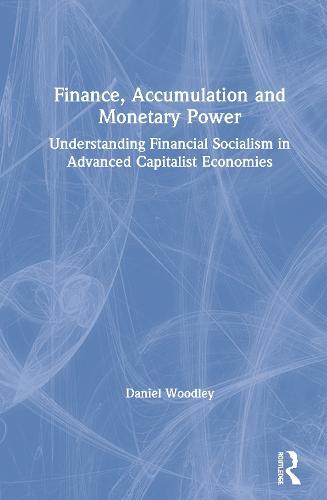
Author: Daniel Woodley
Publisher: Taylor & Francis Ltd
Imprint: Routledge
Weight: 0.518kg
ISBN: 9780367338558
ISBN 10: 0367338556
Pages: 246
Publication Date: 12 November 2019
Audience:
College/higher education
,
Professional and scholarly
,
Tertiary & Higher Education
,
Professional & Vocational
Format: Hardback
Publisher's Status: Active
Availability: In Print

This item will be ordered in for you from one of our suppliers. Upon receipt, we will promptly dispatch it out to you. For in store availability, please contact us.
Reviews
""In Finance, Accumulation and Monetary Power, Daniel Woodley expertly depicts and uncovers the key structural problems that contemporary 'postliberal' capitalism faces. As the book shows, we are moving towards what Woodley terms ‘financial socialism’, in which nation-states and international organisations are required to stabilise an increasingly unstable global capitalism, using monetary policy to prop up the value of money and assets – and in doing so, to sow the seeds of the next crisis. The book is a must-read for anyone with an interest in the ongoing stagnation of the global economy, and the likely sources of the current crisis to come. At the end of a ten-year period of quantitative easing and ultra-loose monetary policy we still exist in a period of 'secular stagnation' – this book goes beyond the surface-level explanations of both mainstream and heterodox economics, to show why this is the case."" David J. Bailey, University of Birmingham, UK
In Finance, Accumulation and Monetary Power, Daniel Woodley expertly depicts and uncovers the key structural problems that contemporary 'postliberal' capitalism faces. As the book shows, we are moving towards what Woodley terms `financial socialism', in which nation-states and international organisations are required to stabilise an increasingly unstable global capitalism, using monetary policy to prop up the value of money and assets - and in doing so to sow the seeds of the next crisis. The book is a must-read for anyone with an interest in the ongoing stagnation of the global economy, and the likely sources of the current crisis to come. At the end of a ten-year period of quantitative easing and ultra-loose monetary policy we still exist in a period of 'secular stagnation' - this book goes beyond the surface-level explanations of both mainstream and heterodox economics, to show why this is the case. David J. Bailey, University of Birmingham, UK
In Finance, Accumulation and Monetary Power, Daniel Woodley expertly depicts and uncovers the key structural problems that contemporary 'postliberal' capitalism faces. As the book shows, we are moving towards what Woodley terms `financial socialism', in which nation-states and international organisations are required to stabilise an increasingly unstable global capitalism, using monetary policy to prop up the value of money and assets - and in doing so to sow the seeds of the next crisis. The book is a must-read for anyone with an interest in the ongoing stagnation of the global economy, and the likely sources of the current crisis to come. At the end of a ten-year period of quantitative easing and ultra-loose monetary policy we still exist in a period of 'secular stagnation' - this book goes beyond the surface-level explanations of both mainstream and heterodox economics, to show why this is the case. - David J. Bailey, University of Birmingham, UK.
In Finance, Accumulation and Monetary Power, Daniel Woodley expertly depicts and uncovers the key structural problems that contemporary 'postliberal' capitalism faces. As the book shows, we are moving towards what Woodley terms `financial socialism', in which nation-states and international organisations are required to stabilise an increasingly unstable global capitalism, using monetary policy to prop up the value of money and assets - and in doing so, to sow the seeds of the next crisis. The book is a must-read for anyone with an interest in the ongoing stagnation of the global economy, and the likely sources of the current crisis to come. At the end of a ten-year period of quantitative easing and ultra-loose monetary policy we still exist in a period of 'secular stagnation' - this book goes beyond the surface-level explanations of both mainstream and heterodox economics, to show why this is the case. David J. Bailey, University of Birmingham, UK
Author Information
Daniel Woodley teaches Politics at DLD College in London, UK, and is the author of numerous books and articles on political theory and international politics, including Fascism and Political Theory (2010) and Globalization and Capitalist Geopolitics (2015).