Overview
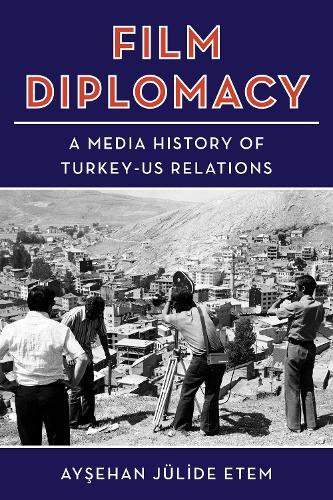
What if the most consequential alliance between the United States and Turkey was not signed-but screened? Beginning in 1930 and crystallizing during the Cold War, the two nations forged an alliance through film: American and Turkish institutions used educational films-short documentaries shown in schools, villages, theaters, and public spaces-not just to inform but to persuade. These films promoted cooperation, encouraged economic development, and modeled ideals of modern citizenship. Yet beneath their instructional surface, they also advanced a racialized vision of progress. Film Diplomacy offers a powerful new account of how film shaped international relations and national identity. Drawing on previously unexamined and recently declassified archives in Turkey and the United States, Ayşehan Jülide Etem demonstrates how both countries used educational films to align institutional agendas and geopolitical interests. The United States built on missionaries' earlier use of film programs while shifting from Christianization to modernization to promote free market capitalism and prevent the spread of communism. Turkish officials embraced film to promote a homogenous, secular, and Western-facing national identity that erased groups such as Armenians, Blacks, Greeks, Jews, and Kurds. In both contexts, whiteness operated as an invisible standard-shaping who belonged, who was excluded, and what counted as modern. By tracing the transnational network of educational cinema, Etem uncovers how film functioned as infrastructure, circulating ideologies, organizing institutions, and training citizens. Moving beyond conventional accounts of propaganda and soft power, this book exposes how film was central to the making of modern Turkey and sheds new light on media's role in global politics.
Full Product Details
Author: Ayşehan Jülide Etem
Publisher: Columbia University Press
Imprint: Columbia University Press
ISBN: 9780231220002
ISBN 10: 0231220006
Pages: 304
Publication Date: 05 May 2026
Audience:
College/higher education
,
Postgraduate, Research & Scholarly
Format: Paperback
Publisher's Status: Active
Availability: Awaiting stock

The supplier is currently out of stock of this item. It will be ordered for you and placed on backorder. Once it does come back in stock, we will ship it out for you.
Reviews
Film Diplomacy offers a comprehensive and beautifully textured account of how film functioned as a key mechanism of US influence in Türkiye between 1930 and 1986. Bridging transnational history, media studies, and governmentality, this book is essential reading for anyone who seeks to understand Cold War cultural politics beyond the simplistic framework of 'propaganda.' -- Perin Gürel, author of <i>Türkiye, Iran, and the Politics of Comparison: America's Wife, America's Concubine</i> Ayşehan Jülide Etem’s pioneering study constitutes the first comprehensive account of film diplomacy within United States–Turkey relations. Film Diplomacy offers a thorough critical analysis that elucidates the nature of the so-called educational films as well as their influence on the audiences they were intended to reach. -- M. Şükrü Hanioğlu, author of <i>Atatürk: An Intellectual Biography</i> Etem breaks new theoretical ground by tracing the links between film, race, and propaganda. She delivers a vivid and meticulously researched account of the racialized discourses of modernization, making it essential reading for anyone interested in Cold War-era cultural politics and transnational relations. -- Bilge Yesil, author of <i>Talking Back to the West: How Turkey Uses Counter-Hegemony to Reshape the Global Communication Order</i>
Film Diplomacy offers a comprehensive and beautifully textured account of how film functioned as a key mechanism of US influence in Türkiye between 1930 and 1986. Through meticulous archival research and expert textual analysis, Etem traces the institutional infrastructures and individuals that made film diplomacy possible, from early film programs established by Protestant missionaries to formal Cold War institutions to the eventual nationalization of the Educational Film Center. Bridging transnational history, media studies, and governmentality, this book is essential reading for anyone who seeks to understand Cold War cultural politics beyond the simplistic framework of “propaganda.” -- Perin Gürel, author of <i>Türkiye, Iran, and the Politics of Comparison: America's Wife, America's Concubine</i> Etem breaks new theoretical ground by tracing the links between film, race, and propaganda. She delivers a vivid and meticulously researched account of the racialized discourses of modernization, making it essential reading for anyone interested in Cold War-era cultural politics and transnational relations. -- Bilge Yesil, author of <i>Talking Back to the West: How Turkey Uses Counter-Hegemony to Reshape the Global Communication Order</i> Although public diplomacy within United States-Turkey relations has been examined to some extent, one of its subfields, namely film diplomacy, has been almost entirely overlooked. Etem’s pioneering study constitutes the first significant attempt to address this gap in scholarly literature. Through meticulous and through research, this book offers a comprehensive account of the subject, and through critical analysis, elucidates of the nature of the so-called educational films as well as their influence on the audiences they were intended to reach. -- M. Şükrü Hanioğlu, Garrett Professor in Foreign Affairs, Princeton University
Film Diplomacy offers a comprehensive and beautifully textured account of how film functioned as a key mechanism of US influence in Türkiye between 1930 and 1986. Through meticulous archival research and expert textual analysis, Etem traces the institutional infrastructures and individuals that made film diplomacy possible, from early film programs established by Protestant missionaries to formal Cold War institutions to the eventual nationalization of the Educational Film Center. Bridging transnational history, media studies, and governmentality, this book is essential reading for anyone who seeks to understand Cold War cultural politics beyond the simplistic framework of “propaganda.” -- Perin Gürel, author of <i>Türkiye, Iran, and the Politics of Comparison: America's Wife, America's Concubine</i> Etem breaks new theoretical ground by tracing the links between film, race, and propaganda. She delivers a vivid and meticulously researched account of the racialized discourses of modernization, making it essential reading for anyone interested in Cold War-era cultural politics and transnational relations. -- Bilge Yesil, author of <i>Talking Back to the West: How Turkey Uses Counter-Hegemony to Reshape the Global Communication Order</i>
Author Information
Ayşehan Jülide Etem is assistant professor of media studies and director of the film studies concentration at the University of Virginia.