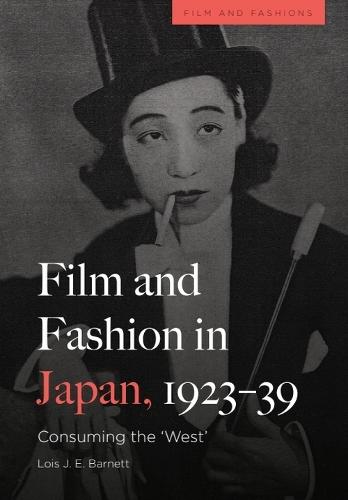
Film and Fashion in Japan, 1923-39: Consuming the 'West'

Author:   Lois Barnett (Postdoctoral Research Associate, School of Oriental and African Studies, University of London (SOAS))
Publisher:   Edinburgh University Press
ISBN:  

9781474497718


Pages:   288
Publication Date:   30 May 2025
Format:   Paperback
Availability:   Temporarily unavailable   Availability explained
The supplier advises that this item is temporarily unavailable. It will be ordered for you and placed on backorder. Once it does come back in stock, we will ship it out to you.

Our Price $57.99 Quantity:  
Add to Cart

Share |

Film and Fashion in Japan, 1923-39: Consuming the 'West'


Overview

The book examines the interaction between the audience member and Japan's film and fashion industries between 1923 and 1939, focusing on Western-inspired fashion objects (as opposed to indigenous Japanese items, such as the kimono). This interdisciplinary book examines the semiotics of dress onscreen within Japan's transcultural media climate, consulting not only film- or fashion-related theoretical bases but also historical and gender-based approaches. The work consults surviving films, print media and advertising materials, allowing insights into lost films and the period's commercial context. The book discusses the role of fashion consumption in defining emergent modern identities and their relationships with new spaces, questioning their arising in Japan and worldwide. Key areas include the expressive Modern Girl image (the Japanese equivalent of the Hollywood flapper); the relationship between the body and sportswear and hybridised dress styles (which combined Japanese and Western-influenced aesthetics); and menswear in the early work of director Ozu Yasujir.

Full Product Details

Author:   Lois Barnett (Postdoctoral Research Associate, School of Oriental and African Studies, University of London (SOAS))
Publisher:   Edinburgh University Press
Imprint:   Edinburgh University Press
ISBN:  

9781474497718


ISBN 10:   1474497713
Pages:   288
Publication Date:   30 May 2025
Audience:   College/higher education ,  Tertiary & Higher Education
Format:   Paperback
Publisher's Status:   Active
Availability:   Temporarily unavailable   Availability explained
The supplier advises that this item is temporarily unavailable. It will be ordered for you and placed on backorder. Once it does come back in stock, we will ship it out to you.

Table of Contents

Introduction: Defining, Theorising and Approaching Japanese Film, Fashion and Modernity Part 1 - On Sartoriality and Speaking: ‘Expressive’ Women and Western Attire 1.1 - Fashionable female imagery between media formats: Tanizaki Jun’ichirō’s Naomi (1924) and the concept of marketable female star ""types"" 1.2 - Sartoriality and Expressivity Pre- and Post- Sound: The Vernacular Voice, The Western-Attired Woman and the City 1.3 - Fashion Commodities Onscreen:the Modern Housewife in Naruse Mikio’s No Blood Relation (Nasanu Naka, 1932) and Masculine Female Attire in Ozu Yasujirō’s Dragnet Girl (Hijōsen no onna, 1933) Part 2 - Sportswear and Hybridity: The National Body and Gender 2.1 - Sportswear and Hybridity: The Middle-Class Housewife as Hybridised Consumer Archetype 2.2 - Women and the Sporting Body 2.3 - Men and the Sporting Body Part 3 - Menswear and the Modern Boy: Ozu Yasujirō and Western Style for Men 3.1 - Historically Contextualising Japanese Male Fashion: Western-style Menswear, the Cinema and Space 3.2 - Opposition to Western-style Menswear and the Desire for ""Authentic"" Japanese Male Commercial Identity Archetypes:Shōchiku’s shōshimin eiga and Ozu’s commercially augmented everyday male life onscreen 3.3 – Was Ozu a ""Modern Boy""? Negotiating Related Sartorial Archetypes Book Conclusion Reference List Filmography

Reviews

This book is a fascinating examination of the market condition for Japanese cinema in a major period of transition. Through detailed historical research it pays attention to the intersection of the film and fashion industries to excavate a vital story of changing sartorial styles and their cultural and social meanings.--Julian Stringer, University of Nottingham


This book is a fascinating examination of the market condition for Japanese cinema in a major period of transition. Through detailed historical research it pays attention to the intersection of the film and fashion industries to excavate a vital story of changing sartorial styles and their cultural and social meanings. -- Julian Stringer, University of Nottingham


Author Information

Lois J. E. Barnett is a Postdoctoral Research Associate at the School of Oriental and African Studies, University of London (SOAS).

Tab Content 6

Author Website:  

Countries Available

All regions
Latest Reading Guide

NOV RG 20252


Shopping Cart
Your cart is empty
Shopping cart
Mailing List