Overview
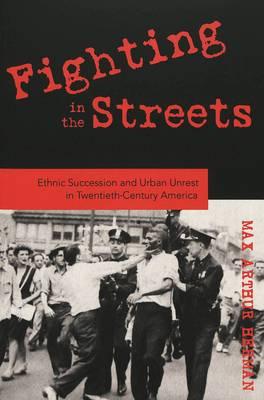
Fighting in the Streets provides a comparative analysis of some of the most severe episodes of urban unrest that took place in twentieth-century America, including the 1919 Chicago Riot, the Detroit Riot of 1943, the Newark and Detroit Riots of 1967, the Miami Riot of 1980, and the 1992 Los Angeles Riot. Examining the patterns of death and destruction of property that occurred during these events, as well as historical evidence regarding struggles for housing, jobs, and political power among members of different racial/ethnic groups, this book makes the case for a general explanatory model of urban unrest as a product of rapid demographic change. Focusing at the neighborhood level, where demographic changes have their greatest impact, Fighting in the Streets posits that riot-related violence is most likely to take place in neighborhoods characterized by high levels of black/white segregation, poverty, unemployment, and rapid population turnover. Such a profile of the riot-prone neighborhood may enable policy makers to avert future violence through targeted economic and political intervention, building community institutions that integrate newcomers and natives. This book is particularly suited for classes in urban studies, race/ethnic relations, and collective behavior/social movements as well as public policy and planning.
Full Product Details
Author: Max Arthur Herman
Publisher: Peter Lang Publishing Inc
Imprint: Peter Lang Publishing Inc
Edition: illustrated edition
Weight: 0.280kg
ISBN: 9780820474557
ISBN 10: 082047455
Pages: 184
Publication Date: 29 September 2005
Audience:
Professional and scholarly
,
Professional & Vocational
Format: Paperback
Publisher's Status: Active
Availability: Available To Order

We have confirmation that this item is in stock with the supplier. It will be ordered in for you and dispatched immediately.
Reviews
« Using sophisticate mapping and statistical techniques to compare several cases of urban ethnic violence that took place in 20th century America, Herman unlocks the fundamental combination of circumstances that fostered urban unrest during three presumably distinct periods in American history. Applying a uniform method to cases from each cycle of collective violence, World War One through World War Two, the 1960s, and the 1980s through 1990s, Herman shows that while surface circumstances surrounding urban riots vary greatly, the root causes do not. Rich historical descriptions both supplement and confirm the quantitative analyses, providing context to explain how rapid changes in population combine with economic inequalities to produce episodes of racial/ethnic conflict. Herman's writing is fluid, and fully convincing. This book is a must read for students of urban politics and collective violence.
Author Information
The Author: Max Herman is an Assistant Professor of Sociology at Rutgers University-Newark. He received his B.A. from Tufts University in Political Science and Social Psychology, his M.A. in Sociology from Yale University, and his Ph.D. in Sociology from the University of Arizona. In additional to his current position at Rutgers, Dr. Herman has taught at Rice University and Oberlin College. In addition to studying urban unrest his current interests include Black-Jewish relations and Witness Behavior during the 1950's Red Scare.