Overview
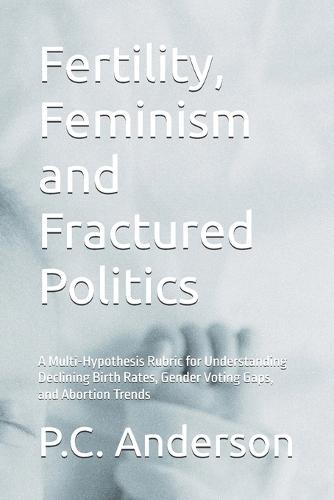
Birth rates are collapsing. Gender politics are polarizing. Abortion remains fiercely contested. And beneath these headlines lies one of the most consequential demographic transformations in modern history. Fertility, Feminism and Fractured Politics offers a rare kind of clarity: a rigorous, transparent framework for understanding why these shifts are happening-and what they mean for the future of families, economies, and democratic societies. Rather than blaming a single cause, the book evaluates eight competing explanations for declining fertility and widening gender divides: ideological change, economic pressures, education and opportunity, reproductive technology, institutional trust, male-female value divergence, digital culture, and policy incentives. Each hypothesis is tested against the strongest available evidence from CDC data, Pew surveys, Guttmacher abortion estimates, OECD policy comparisons, and county-level political patterns. Readers will learn: Why U.S. fertility has fallen to record lows (general fertility rate 53.1 in 2025) even as desired family size remains higher. Why conservative counties and religious communities maintain significantly higher birth rates than progressive, secular, or high-cost urban areas. How housing costs, childcare prices, and economic insecurity interact with cultural norms to shape family decisions. Why post-Dobbs abortion numbers remained stable ( 1.126 million in 2025) despite state restrictions, and what this reveals about demand, telehealth, and adaptation. How social media and digital culture accelerated ideological divergence among young women after 2010. Why no single explanation-economic, cultural, or technological-can fully account for the patterns we observe. At the heart of the book is a 14-dimension scoring rubric that evaluates each hypothesis on explanatory scope, predictive power, empirical support, falsifiability, subgroup robustness, policy sensitivity, and more. The result is a clear ranking of which forces matter most-and how they interact. Economic constraints emerge as the strongest overall driver, but ideology, religiosity, and policy design remain indispensable parts of the causal network. The book goes further, offering: Causal diagrams and interaction models showing how economics, culture, and technology reinforce one another. Bayesian updating that transparently revises the weight of each hypothesis as new evidence arrives. Scenario projections for the future of fertility under different economic, cultural, and policy conditions. Policy implications grounded in real-world experiments from the Nordics, Hungary, East Asia, and U.S. states. A candid discussion of limitations, data gaps, and unresolved debates, inviting readers to replicate or extend the framework. In an era of aging societies and polarized politics, understanding these forces is not optional. It is essential. Fertility, Feminism and Fractured Politics is for readers who want more than slogans-who want a disciplined, evidence-based way to think about one of the defining challenges of the 21st century. Whether you approach the topic from economics, sociology, politics, or personal curiosity, this book offers a rare combination of analytical rigor, intellectual humility, and cross-ideological honesty.
Full Product Details
Author: P C Anderson
Publisher: Independently Published
Imprint: Independently Published
Dimensions:
Width: 15.20cm
, Height: 0.30cm
, Length: 22.90cm
Weight: 0.095kg
ISBN: 9798258794109
Pages: 62
Publication Date: 25 April 2026
Audience:
General/trade
,
General
Format: Paperback
Publisher's Status: Active
Availability: Available To Order

We have confirmation that this item is in stock with the supplier. It will be ordered in for you and dispatched immediately.