Overview
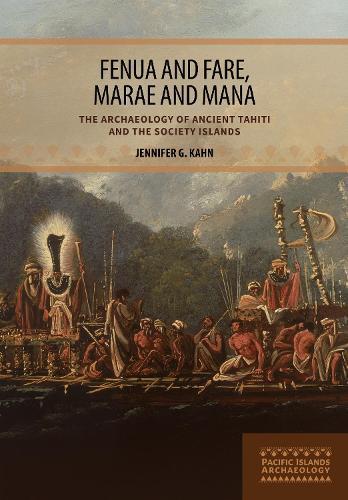
In 1767 the shores of Tahiti first appeared in the sights of Captain Samuel Wallis, and ever since, this tropical locale has captured the imagination of explorers, merchants, missionaries, historians, anthropologists, archaeologists, and others. Fenua and Fare, Marae and Mana brings readers back to the time before European contact, starting with the settlement of the archipelago by Polynesian voyagers, or the Mā'ohi, some 1,000 years ago. From the massive stone ruins of chiefly households, agricultural terraces, and religious temples (marae) to sacred foods, clothing, and war cults, Jennifer G. Kahn delves into every aspect of Mā'ohi life. Drawing on current anthropological and archaeological research, and data from her own field research and that of others, Kahn explores the development of Mā'ohi politics, economies, religion, and social relationships, and their connections to the local environment. Anthropologists and archaeologists have previously investigated how ecology and natural resources, demographic growth, and cultural factors such as status rivalry, religion, and ideology spurred sociopolitical changes in the Society Islands. But how did Mā'ohi settlements coalesce into the powerful chiefdoms encountered by Captain Cook in the late 1700s? Synthesizing a vast amount of archaeological data, oral histories, and historical accounts, Kahn traces changes in Mā'ohi material culture, land use, diet, subsistence, agriculture, settlement patterns, environment, and residential and ritual architecture to present the first authoritative cultural sequence for the pre-contact Society Islands. She also addresses a long-standing debate in historical anthropology by arguing that Mā'ohi society had multiple tiers of chiefs and settlement hierarchies prior to European contact, thus forming a complex chiefdom. Integrating anthropology, archaeology, indigenous history, and theory, Kahn lays out a new model for interpreting complex chiefdoms that blends bottom-up and top-down perspectives on social change. With special attention to inequality and environmental change, Fenua and Fare uses collective action theory to develop a more nuanced political history of social change, offering fresh insight on the lives and interactions of commoners, land managers, high chiefs, and secondary chiefs. Readers will come away with a new appreciation for how social inequality blooms and grows, not just in the Society Islands, but elsewhere in Polynesia and beyond.
Full Product Details
Author: Jennifer G. Kahn
Publisher: University of Hawai'i Press
Imprint: University of Hawai'i Press
ISBN: 9780824898489
ISBN 10: 0824898486
Pages: 277
Publication Date: 28 February 2025
Audience:
College/higher education
,
Postgraduate, Research & Scholarly
Format: Hardback
Publisher's Status: Active
Availability: Available To Order

We have confirmation that this item is in stock with the supplier. It will be ordered in for you and dispatched immediately.
Reviews
In Fenua and Fare, Marae and Mana, Jennifer Kahn brings an immense amount of information together to build the first, cohesive archaeological sequence for the Society Islands. Kahn does a masterful job synthesizing studies from divergent archaeological threads and traditions to provide an accessible survey of literature, data, and interpretations of pacific archaeology to students and researchers. Kahn's book also helpfully explicates the various factors that drive change across the archipelago.--Seth Quintus, University of Hawai`i at Mānoa
Author Information
Jennifer G. Kahn is associate professor of anthropology at the College of William & Mary.