Overview
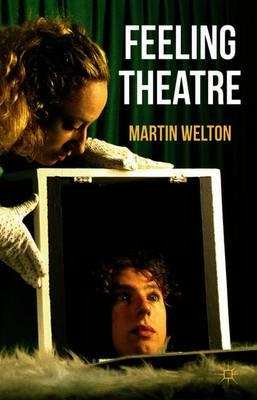
Why is it that in going to see plays we are also touched or moved by them, and is there more than metaphor involved in such claims? Considering these and other questions, this book examines a range of contemporary performance works in which performers and their audiences occupy a shared realm of feelings, in which the play is not always the thing.
Full Product Details
Author: Martin Welton
Publisher: Palgrave Macmillan
Imprint: Palgrave Macmillan
Dimensions:
Width: 15.20cm
, Height: 1.70cm
, Length: 22.90cm
Weight: 0.435kg
ISBN: 9780230245631
ISBN 10: 0230245633
Pages: 184
Publication Date: 22 November 2011
Audience:
Professional and scholarly
,
Professional & Vocational
Format: Hardback
Publisher's Status: Active
Availability: In Print

This item will be ordered in for you from one of our suppliers. Upon receipt, we will promptly dispatch it out to you. For in store availability, please contact us.
Reviews
'Welton's Feeling Theatre: Staging Sensation provides a thought-provoking overview of how the senses are fundamental to theatre experiences -- both in practice and appreciation - in a diversity of ways. The questioning approach and accessible tone is highly relevant to contemporary performance practice and analysis. In addition to its place within educational contexts Feeling Theatre will also be of interest to those currently engaged in professional performance practice. The author's own concern with practice, alongside the consideration of example work from a variety of performances, lends itself to the practitioner perspective in this regard. The foregrounding of 'practice-based research' with a focus on the interdisciplinary is apposite to both academic and artistic perspectives. The overriding strength of Feeling Theatre is that it deliberates on the particularly affective nature of live performance and provides a clear argument for the need to expand the sensorium of theatrical criticism beyond the audio-visual to consider the full and interactive sentience of the human body and the varied ways in which it 'makes sense' during and following a variety of theatrical events. The elision of 'feeling' (in its various modes), looking and listening foregrounds how the focus shifts within and beyond seeing and hearing and adds a sensual touch to the analysis; a writerly 'feel' that migrates between emotion, cognition and touch. In considering 'theatre's full-fleshed perceptivity' Welton breaks down each chapter to focus on specific affects ascribed to certain senses and, in so doing, explores the complex nature of perceptual experience in performance practice to examine what it is to experience 'feelingly'. The 'getting a feel for how it goes' mantra is a fundamental precept of the book and shows a sensitivity to the exchange that occurs in performance between performer and spectators; a factor that places Feeling Theatre firmly within the vital and ongoing movement in embodied thinking. ' -- Jo Machon, Lecturer in Theatre, Brunel University, UK
'Welton's Feeling Theatre: Staging Sensation provides a thought-provoking overview of how the senses are fundamental to theatre experiences - both in practice and appreciation - in a diversity of ways. The questioning approach and accessible tone is highly relevant to contemporary performance practice and analysis. In addition to its place within educational contexts Feeling Theatre will also be of interest to those currently engaged in professional performance practice. The author's own concern with practice, alongside the consideration of example work from a variety of performances, lends itself to the practitioner perspective in this regard. The foregrounding of 'practice-based research' with a focus on the interdisciplinary is apposite to both academic and artistic perspectives. The overriding strength of Feeling Theatre is that it deliberates on the particularly affective nature of live performance and provides a clear argument for the need to expand the sensorium of theatrical criticism beyond the audio-visual to consider the full and interactive sentience of the human body and the varied ways in which it 'makes sense' during and following a variety of theatrical events. The elision of 'feeling' (in its various modes), looking and listening foregrounds how the focus shifts within and beyond seeing and hearing and adds a sensual touch to the analysis; a writerly 'feel' that migrates between emotion, cognition and touch. In considering 'theatre's full-fleshed perceptivity' Welton breaks down each chapter to focus on specific affects ascribed to certain senses and, in so doing, explores the complex nature of perceptual experience in performance practice to examine what it is to experience 'feelingly'. The 'getting a feel for how it goes' mantra is a fundamental precept of the book and shows a sensitivity to the exchange that occurs in performance between performer and spectators; a factor that places Feeling Theatre firmly within the vital and ongoing movement in embodied thinking. ' - Jo Machon, Lecturer in Theatre, Brunel University, UK
Author Information
MARTIN WELTON Lecturer in Performance at Queen Mary, University of London, UK. His research centres on the sense in performance - in particular the condition of 'feeling'. This research also encompasses practice, and recent projects include working as a performer and devisor with Sound and Fury Theatre Company, UK, and Theater ASOU, Austria.